Diabetes is a hell of a disease. While many people view it as nothing more than the inability to eat sweets, it is actually much more devastating than just that. If untreated, having high glucose levels can wreak havoc on a patient's body -- these folks can go blind, have limbs amputated, or worst of all, die.
Diabetic eye disease is caused by retinopathy. Affected diabetics can have small tears inside the eye, causing bleeding. Over time, they can lose vision, and ultimately, they can go blind. Luckily, Google has been trying to use machine learning to detect diabetic retinopathy. Guess what? The search giant has seen much success. Not only are the computers able to detect the disease at the same level as ophthalmologists, but Google is actually slightly better!
"A few years ago, a Google research team began studying whether machine learning could be used to screen for diabetic retinopathy (DR). Today, in the Journal of the American Medical Association, we’ve published our results: a deep learning algorithm capable of interpreting signs of DR in retinal photographs, potentially helping doctors screen more patients, especially in underserved communities with limited resources", says Lily Peng MD PhD, Product Manager, Google.
Peng explains, "the results show that our algorithm’s performance is on-par with that of ophthalmologists. For example, on the validation set described in Figure 2, the algorithm has a F-score (combined sensitivity and specificity metric, with max=1) of 0.95, which is slightly better than the median F-score of the 8 ophthalmologists we consulted (measured at 0.91)".
It is important to note that Google's research will not cure diabetes or diabetic retinopathy. What the search giant has accomplished, however, is the ability to better detect eye issues. True, Google only bests ophthalmologists slightly -- negligibly, really -- but it is only the beginning. This machine learning technology can only improve.
In the future, it is totally possible that Google's work will lead to earlier detection, and ultimately, real lives being positively impacted. In other words, some diabetic people could avoid painful surgery because the bleed is detected early enough for lifestyle changes to be used instead.
If you are interested, you can dive deeper into the research here.
Are you happy to see machine learning be leveraged to help humanity? Tell me in the comments.
Yet another AI update from Google, folks. A couple days ago, we saw how Google’s translation neural networks successfully created their own secret language to talk about things we can’t comprehend. Well, now they’re working to create the most accurate lip-reading software ever — even advanced than our own ‘human’ skills.
Researchers from Google’s DeepMind AI division and the University of Oxford are working together on this project. To accomplish the task, a cohort of scientists fed thousands of hours of TV footage — 5000 to be precise — from the BBC to a neural network. It was made to watch six different TV shows, which aired between the period of January 2010 and December 2015. This included 118,000 difference sentences and some 17,500 unique words.
The primary task of the AI was to annotate the video footage. But, in the published research paper, Google and Oxford researchers describe their ambition for the project as:
The goal of this work is to recognise phrases and sentences being spoken by a talking face, with or without the audio. Unlike previous works that have focussed on recognising a limited number of words or phrases, we tackle lip reading as an open-world problem – unconstrained natural language sentences, and in the wild videos
To understand the progress, it successfully deciphered words with a 46.8 percent accuracy. The neural network had to recognize the same based on mouth movement analysis. The under 50 percent accuracy might seem laughable to you but let me put things in perspective for you. When the same set of TV shows were shown to a professional lip-reader, they were able to decipher only 12.4 percent of words without error. Thus, one can understand the great difference in the capability of the AI as compared to a human expert in that particular field.
But this is not the only transcribing AI which has surfaced recently. This research follows pursuit to a similar work published by a separate group of researchers from University of Oxford itself. Using similar techniques but different input data, this cohort was able to develop a lip-reading AI called LipNet.
This neural network achieved 93.4 percent accuracy during analysis, compared to 52.3 percent human accuracy. It was able to attain such high numbers because the research group tested the AI using specially recorded footage where volunteers speaking formulaic sentences.
But the two research groups are now looking to expedite their analysis and use materials from each other’s research to truly understand the capabilities of their individual neural networks. Google’s DeepMind researchers have christened the said neural network — “Watch, Listen, Attend, and Spell” and it could most likely be used for a host of application. The scientists believe it might help hearing-impaired people understand conversations, and could also be helpful in annotating silent films, and instructing virtual assistant by mouthing words to a camera.
Tại sao những gã khổng lồ công nghệ đang chi lượng lớn khủng cho trí tuệ nhân tạo?
Trí tuệ nhân tạo (Al) đã phát triển được một thời gian dài và người ta vẫn còn đang chờ đợi con robot C-3PO đầu tiên (robot có khả năng nói chuyện trong phim Star War). Nhìn vào lượng tiền lớn mà các công ty công nghệ và các nhà đầu tư mạo hiểm đổ vào lĩnh vực này, Al quả là đang có bước tiến bộ lớn, mặc dù các nhà đầu tư đang tìm kiếm những thứ khác hơn là một robot biết nói chuyện.
“Về lâu dài, tôi nghĩ rằng chúng tôi sẽ phát triển điện toán định hướng từ mobile-first (ưu tiên di động) sang Al-first (ưu tiên trí tuệ nhân tạo). Và tôi nghĩ rằng chúng tôi đang ở vị trí tiên phong trong việc phát triển lĩnh vực này”, Sundar Pichai, CEO của Google.
Google là nhà đầu tư tích cực nhất với 9 thương vụ mua lại bắt đầu từ năm 2011.
“Các kỹ sư Al chất lượng cao là rất khan hiếm, những ông lớn đang tụt lại phía sau trong cuộc đua Al (Twitter, AOL và hàng chục hãng khác) thấy Google đang đạt được những gì và họ đang vật lộn để không bị bỏ lại phía sau,” hội viên quản lý tại Magister Advisors, một ngân hàng đầu tư có trụ sở tại Luân Đôn, Victor Basta, cho biết trong một bài đăng trên Linkedln.
Trí tuệ nhân tạo dựa trên giả định rằng một cỗ máy hay một máy tính có thể dùng để “giả lập” trí thông minh của con người. Thuật ngữ này lần đầu tiên được đưa ra vào năm 1956 khi một nhóm các nhà nghiên cứu Mỹ đã cùng nhau đến Đại học Dartmouth để thảo luận cách một chương trình máy tính có thể hoạt động như con người.
Kỳ thủ cờ vây Hàn Quốc Lee Se-Dol đấu cờ với chương trình trí tuệ nhân tạo của Google, AlphaGo, tại Google DeepMind Challenge Match tại Seoul, Hàn Quốc vào ngày 13/3. (Ảnh: Google via Getty Images)
Đột phá về công nghệ trong những năm gần đây đã mở rộng các ứng dụng của Al. Hiện tại, trí tuệ nhân tạo đã được sử dụng trong một loạt các lĩnh vực như khoa học máy tính, y tế, tài chính, an ninh, quảng cáo, viễn thông, vận tải và ô tô.
Frank Chen, một đối tác tại công ty đầu tư mạo hiểm Silicon Valley Andreessen Horowitz định nghĩa Al là “một trong những thay đổi công nghệ lớn nhất đang xảy ra trong nền công nghiệp”.
“Chúng tôi nghĩ rằng trí thông minh nhân tạo, đặc biệt là deep learning có thể trở nên uyên thâm và thậm chí có thể còn lớn hơn cả [di động và điện toán đám mây]”, Chen nói trong một video trên trang web Andreessen Horowitz.
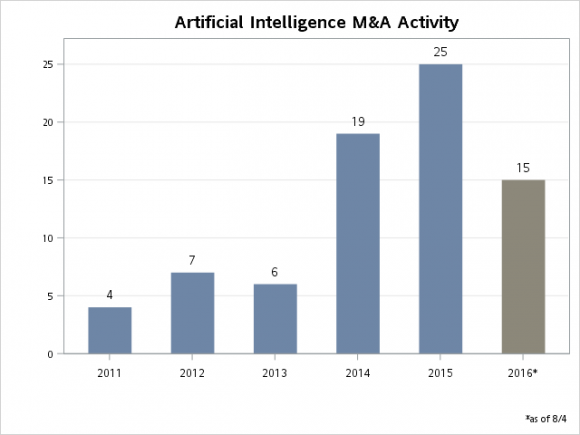
Số lượng giao dịch mua bán và sáp nhập trong lĩnh vực trí tuệ nhân tạo. (Nguồn: Pitchbook)
Sự quan tâm đến lĩnh vực Al bỗng nhiên tăng vọt là do những cải tiến trong lĩnh vực học hỏi tự động (machine learning), đặc biệt là trong lĩnh vực deep learning. Deep learning tạo ra trí tuệ từ nhiều lớp xử lý thông tin và có thể được ứng dụng vào vào các chức năng như nhận dạng hình ảnh hay nhận dạng giọng nói.
Cuộc chạy đua mua lại các startup AI
Trong những năm gần đây, các gã khổng lồ công nghệ Hoa Kỳ đã nhận ra tầm quan trọng của Al cho dịch vụ của họ và bắt đầu đổ tiền vào những công ty khởi nghiệp về Al. Những vụ sáp nhập và mua lại đã được bắt đầu từ năm 2014.
Những gã khổng lồ công nghệ như Google, Twitter, Salesforce, Apple, Intel, Yahoo, IBM và AOL đã mua gần 30 startup Al trong năm năm qua, theo CB Insights. Năm vụ mua lại đã xảy ra trong năm 2016.
Một trong những giao dịch đáng chú ý nhất là vụ Google mua lại startup deep learning của Khoa khoa học máy tính của Đại học Toronto năm 2013. Thương vụ này đã giúp Google cải thiện tính năng tìm kiếm hình ảnh của mình.
Một thỏa thuận quan trọng khác của Google là mua lại công ty công nghệ DeepMind có trụ sở tại Anh vào năm 2014. Google đã chi 600 triệu USD cho DeepMind, công ty có công nghệ Al mà gần đây đã đánh bại nhà vô địch cờ vây thế giới.
Twitter đứng thứ hai sau Google trong việc mua lại Al, với 4 giao dịch lớn kể từ năm 2014. Twitter gần đây đã mua startup xử lý hình ảnh Magic Pony có trụ sở tại Vương quốc Anh. Theo báo cáo của phương tiện truyền thông, Twitter đã chi 150 triệu USD cho startup gồm 14 người này. Victor Basta nói trong bài viết của mình rằng, với định giá 10,7 triệu USD cho mỗi nhân viên, thỏa thuận này “đã làm nổi bật một thương vụ giao dịch cao cấp trong lĩnh vực Al mà có bản chất giống như mua lại một đội bóng”.
Ông nói: “Vương quốc Anh cũng là một mảnh đất màu mỡ cho các công ty Al do ảnh hưởng của Đại học Cambridge, Oxford, Imperial và các công ty đầu tư mạo hiểm vào Al như White Star, Playfair, Notion”.
Apple và Salesforce đã tham gia cuộc chạy đua “mua sắm” này vào năm ngoái và mỗi công ty đã mua lại ba startup công nghệ Al kể từ đó.
Facebook cũng là một nhà đầu tư lớn vào Al nhưng chủ yếu là phát triển công nghệ trong nội bộ. Công ty này đã dành riêng một phòng thí nghiệm để nghiên cứu Al vào năm 2013 và đã thuê các chuyên gia về deep learning. Công ty sử dụng Al để cá nhân hóa những gì quan trọng với mỗi người dùng và thiết lập nội dung có liên quan trên timeline.”
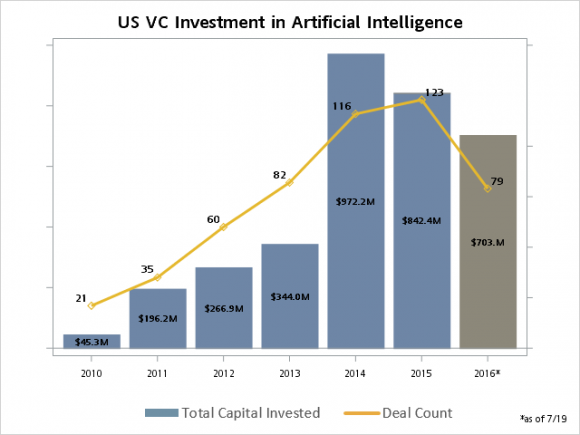
Các nhà đầu tư mạo hiểm Hoa Kỳ đầu tư vào lĩnh vực trí thông minh nhân tạo. (Nguồn: Pitchbook)
Đầu tư mạo hiểm vào lĩnh vực Al cũng bùng nổ trong những năm gần đây. Sự bùng nổ đã bắt đầu từ hai năm trước khi “2014 được xem là một năm thành công đối với đầu tư mạo hiểm vào startup Al có trụ sở tại Mỹ, với vốn đầu tư và số lượng hợp đồng tăng so với năm trước tương ứng là 183% và 41%”, theo một báo cáo của Pitchbook về dữ liệu mua bán và sáp nhập.
Giá trị của nhân sự
Công ty trí tuệ nhân tạo được mua lại phần lớn hay toàn bộ nhóm nhân sự cùng với khả năng của họ. Nhân viên của những công ty này đang được giao dịch giống như cầu thủ bóng đã chuyên nghiệp.
Al có lẽ là khu vực duy nhất trong lĩnh vực công nghệ nơi giá trị thuần của những nhóm nhân sự đã vượt qua giá trị doanh nghiệp một cách đáng kể. – Victor Basta, hội viên quản lý, Magister Advisors.
Theo một phân tích được thực hiện bởi công ty của ông, Magister Advisors, giá trung bình trả cho một startup Al tính trên mỗi nhân viên là 2,4 triệu USD. Tuy nhiên, người mua không sử dụng chỉ số này để đánh giá giá trị của startup Al, họ sẽ chỉ dùng chúng như kiểm tra chéo để tránh trả giá quá cao.
Năm nhóm đắt nhất và giá trả cho mỗi nhân viên:
(Nguồn: Magister Advisors)
“Những công ty này được định giá dựa trên rổ giá cả chung. Những người mua tiềm lực lớn hơn sẵn sàng trả 25-50 triệu USD cho năng lực và một số công cụ, hơn là một công ty thực sự với bộ máy và tiềm năng thu nhập trong tương lai”, Basta trả lời cho báo Epoch Times.
“Giá chính xác sau đó được kiểm tra chéo để xem xét tương quan với kích thước nhóm, phân khúc hấp dẫn đầu tư và khả năng của từng cá nhân trong nhóm cấp cao”.
Theo Basta, mặc dù có nhu cầu, việc định giá Al vẫn không tăng vọt.
Ông nói: “Định giá 2,4 triệu USD cho mỗi nhân viên không phải là mức giá cao – khoảng 5 triệu USD cho mỗi nhân viên”.
Matrix PowerWatch là chiếc đồng hồ thông minh đầu tiên trên thế giới mà bạn sẽ không bao giờ phải lo lắng về việc sạc pin.
Cơ thể chúng ta ở trạng thái bình thường tỏa ra năng lượng khoảng 100 Watt dưới dạng nhiệt, tương đương với một bóng đèn đang cháy. Còn khi vận động thì con số này có thể lên tới 1 kW, tương đương với năng lượng một căn hộ trung bình tiêu thụ.
Lấy năng lượng từ chính thân nhiệt của người đeo và chuyển đổi thành điện năng, chiếc đồng hồ này sẽ hoạt động khi bạn đeo lên tay, và “đi ngủ” khi bạn tháo nó ra. Khi đeo lên tay, nó cũng hiển thị lượng điện năng mà bạn đang tạo ra.
Ngoài ra, Matrix PowerWatch có thể theo dõi chính xác lượng calories mà bạn đốt cháy trong ngày, mức độ vận động và ngủ của bạn.
Nó cũng có thể kết nối không dây với điện thoại thông minh, tự thay đổi theo múi giờ và mặt đồng hồ có thể thay đổi theo sở thích thời trang của người dùng.
Về độ bền, sản phẩm được chế tạo bằng hợp kim nhôm chất lượng tương đương với trong sản xuất hàng không, và vì bạn không bao giờ phải tháo nó ra để sạc pin, chiếc đồng hồ có khả năng chống nước ở độ sâu lên tới 50m.
Công ty sản xuất hiện đang gây quỹ trên Indiegogo và bạn có thể đăng ký ủng hộ họ ở mức giá 129 USD, dự kiến giao hàng vào tháng 7/2017.
Tỷ phú Vinod Khosla chia sẻ tầm nhìn về tương lai nơi trí tuệ nhân tạo (AI) sẽ đảm nhận 80% công việc trong lĩnh vực IT. Nhưng danh sách các ngành được tự động hóa sẽ không chỉ dừng ở đó…
Tỷ phú Khosla (ảnh: Max Whittaker/Flickr)
Làn sóng tự động hóa trong lĩnh vực IT
Tại Hội nghị Structure ngày 9/11 ở San Francisco, nhà tiên phong trong lĩnh vực công nghệ – tỷ phú Vinod Khosla đã nhấn mạnh rằng 80% công ăn việc làm trong lĩnh vực công nghệ sẽ bị trí tuệ nhân tạo (AI) thay thế. “Tôi nghĩ điều đó thú vị,” người sáng lập công ty Sun Microsystems và quỹ đầu tư Khosla Ventures nói. Đây quả là một nhận định lạ lùng khi nói về mất mát việc làm.
Ngồi trước đa số khán giả là giám đốc công nghệ thông tin (CIO) và lãnh đạo trong giới công nghệ, Khosla kể ra một vài ví dụ để chứng minh:
Nutanix là một công ty đã nhận khoản đầu tư của Khosla Ventures. Công ty này tập hợp các chuyên gia về cơ sở hạ tầng máy tính để thúc đẩy việc tự động hóa công việc kết nối mạng giữa các server.
Công ty startup Mesophere, đơn giản hóa việc cài đặt và bảo trì phần mềm trên server.
Ông Khosla tin rằng trí tuệ nhân tạo sẽ xâm nhập vào các phòng server và trung tâm dữ liệu khắp thế giới, thay thế cho các nhân viên IT con người, và cắt giảm mạnh chi phí nhân sự của bộ phận IT.
Xin chào, kỷ nguyên của trí tuệ nhân tạo
Nhận định của Khosla được chào đón với một chút khó chịu, đặc biệt là khi dự đoán về mất việc làm do AI đã gây lo lắng cho nhiều người. Khosla đã nhanh chóng trấn an khán giả rằng “chúng ta nằm trong 20% còn lại, không phải 80% bị tự động hóa.”
Hẳn là các lãnh đạo giới công nghệ và CIO thì không cần lo lắng, nhưng đối với nhiều người khác thì bức tranh tương lai có thể ảm đạm hơn nhiều so với trước đây.
Đa số người ta nghĩ rằng AI chỉ có thể thay thế các công việc tay chân, giới “cổ xanh” như lái taxi hay xe tải. Nhưng các lĩnh vực “cổ trắng” như bác sĩ, luật sư và kế toán cũng nằm trong danh sách thay thế. Và giờ là đến IT.
Ví dụ:
Người ta nhận thấy số lượt ghé thăm các trang web của mạng lưới y tế Web MD đã vượt qua tổng số lần đi khám bác sĩ ở Mỹ.
Các trang thương mại điện tử đang dùng trí tuệ nhân tạo để giải quyết tranh chấp, eBay dùng “giải pháp tranh chấp online” để xử lý 60 triệu vụ việc khiếu nại, thay vì dùng đến luật sư, con số này là gấp 3 lần số vụ đơn kiện hàng năm ở Mỹ.
Trong năm nay, một công ty đã tuyển dụng luật sư trí tuệ nhân tạo “Ross” để xử lý các vấn đề phá sản.
Tất cả những ví dụ này đều cho thấy xu hướng thay đổi trong các ngành dịch vụ chuyên nghiệp.
Nói một cách công bằng, nhận định của Khosla về “thú vị” cũng có một số lý do nhất định. Máy móc ngày càng làm được nhiều điều hơn và con người làm cho các quy trình tự động nhanh và rẻ hơn, điều này cũng mang lại những lợi ích kinh tế.
Như vậy, điều đáng lưu tâm là, những nhà hoạch định chính sách sẽ làm gì để cân bằng giữa an sinh xã hội và phát triển công nghệ?
Just a couple of weeks ago, Facebook made industry news when technology reporters discovered a Jobs tab on their business page. The social network later confirmed that it was experimenting with a suite of sourcing tools to capitalize on the boom in social recruiting. Workforce industry experts believe that Facebook may be trying to muscle in on LinkedIn’s sacred grounds. However, even bigger revelations came November 15 when Google announced its own foray into the realm of talent acquisition — a move that staffing insiders have been predicting for some time. The fascinating twist with Google is that the Internet giant has no plans to build a standalone technology, such as a branded applicant tracking system (ATS), online recruitment platform or vendor management system (VMS). Instead, Google is offering “Cloud Jobs API,” which allows workforce technology developers to integrate robust machine learning features into their systems.
What Is Cloud Jobs API?
Google is promoting its targeted API as a powerful job search and discovery platform dedicated to improving processes in the talent industry. Machine learning forms the core of the technology and its potential boon to staffing professionals. Google describes the innovation on its site:
Company career sites, job boards and applicant tracking systems can improve candidate experience and company hiring metrics with job search and discovery powered by sophisticated machine learning. The Cloud Jobs API provides highly intuitive job search that anticipates what job seekers are looking for and surfaces targeted recommendations that help them discover new opportunities.
To ensure that users receive the most relevant search results and recommendations, the API relies on Google’s advances in machine learning to understand how job titles and skills correlate. It then compiles the data to determine the closest match between job content, location and seniority.
The Value of Cloud Jobs API
Meaningful Search Results
When Google first launched its search functionality, it revolutionized the Internet. It masked cutting-edge algorithms in a simple interface, which delivered the most comprehensive and relevant results available — and disrupted an entire industry. Google is no longer just a technology solutions provider, it’s become a cultural institution. Now, it’s expanding that reach into our industry.
Recruiters today still face challenges with cumbersome job boards, muddled sourcing systems and attempts to cull vital information from a lot of digital noise. That’s precisely what Google intends to help them overcome.
As Google explains: “Job postings are often worded in industry- and company- specific jargon that job seekers don’t search for. Cloud Jobs API provides intuitive job search that surfaces relevant opportunities by leveraging a complete graph of how job titles, skills, and seniority relate to one another.”
Dynamic Job Discovery
The inherent machine learning in Cloud Jobs API promises to bring big data directly to users, while compacting it into right-sized data. Google’s platform will monitor job searching behavior and the data present in career path progressions to suggest opportunities. It will also recommend additional roles that are aligned to a job seeker’s skill sets and interests. As the API collects more information, it can render more accurate assessments.
Because cultural fit has taken precedence with candidates, recruiters, hiring managers and contingent workforce leaders alike, Cloud Jobs API could streamline the process of creating ideal matches.
Simple Integration and Other Features
Simplicity in user functionality has always been a hallmark of Google. The company assures staffing industry technology providers that integrating the API is a fairly effortless undertaking. Despite this ease, however, the API will continue to support a wide range of critical features.
Synonym and acronym expansion: The system can incorporate relevant results even when job postings are written in company specific terms, industry jargon or acronyms that candidates may not be familiar with.
Job enrichment: Results are optimized with enhanced content that includes additional details about location, employment type, benefits and more.
Geographical data: Tapping into the power of Google’s robust geolocation systems, Cloud Jobs API will interpret countless forms of location data to help users refine their searches. “From street address to colloquial regions (Bay Area, Research Triangle) to precise geo-coordinates,” Google writes, the platform will enable “fine grained job filtering based on distance and commute times.”
Seniority alignment: Google says the API understands the seniority requirements of positions and returns only the relevant results.
Dynamic recommendations: The API encourages users to mark which jobs they liked and which they considered poor fits. The “recommendation engine” records these inputs and factors them into future searches for optimized suggestions.
“At the heart of Cloud Jobs API,” Google explains, “there are two main proprietary ontologies that encode knowledge about occupations and skills, as well as relational models between these ontologies.” For the sake of avoiding confusing tech terms, let’s just call these “ontologies” data models.
The first data model deals with occupation. It includes about 30 general job categories (e.g., accounting and finance, human resources, hospitality, etc.), over 1,000 occupational families (e.g., database administrators), and 250,000 specific job titles.
The second data model focuses on skills. Google claims that it can define and organize about 50,000 hard and soft skill sets with different types of relationships. Basically, it seems to produce an analogy along the lines of “this hard skill is related to this soft skill.” Or, as an example, we could say “customer service is related to strong interpersonal communication skills.”
Machine Learning
Of course, the breakthrough of Cloud Jobs API comes from access to Google’s machine learning algorithms, which play a predominant role in driving the performance of talent acquisition strategies. The first step involves cleansing job titles. Google’s API is programmed to standardize the titles it sees, which represents a huge benefit to job seekers and job posters.
The APi initially removes language not directly related to the occupation’s definition. This includes location, employment type, salary details, company names, advertising phrases and “administrative jargon.”
Next, the API takes the scrubbed job descriptions and attempts to recognize actual occupations from vague expressions. Google illustrates the process with an example: “The title ‘retail sales’ maps to the broad category ‘Sales and Retail,’ while a ‘flooring installer’ job title encompasses ‘carpet installer,’ ‘floor layer,’ and ‘tile and marble setter’ occupation families.” The system can detect titles that are not occupations and assign a confidence score to the mappings.
After these processes, machine learning takes over and supports the following functions:
Identifying an occupation based on a candidate’s search queries and then matching them to the occupation data model with a confidence score.
Mapping job titles in postings to relevant roles in the occupation data model with a confidence score.
Detecting specific skills in candidate search queries and matching them to values in the skills data model.
Extracting relevant skills from job postings and matching them to values in the skills data model.
Computing the relationship between occupations and skills.
Who’s Already Using Cloud Jobs API?
According to ERE Editor-in-Chief Todd Raphael, three big industry firms have already incorporated the API into their systems: Dice, CareerBuilder and Jibe. In his article, Todd provides insights from this early batch of Google partners. The results enjoyed by CareerBuilder are particularly compelling and seem to hint at great potential for the API.
Dice. The company says it was selected “specifically for its technology focus and position in the technology community.”
CareerBuilder. Google says that CareerBuilder created “a prototype in just 48 hours, found improved, more accurate results when compared to its existing search algorithm.” Google gives an example of a search for “part time” and how the results are “richer” because of the use of synonyms like PT. CareerBuilder appears to be just testing the tool and later expanding it to greater use among its customers.
Jibe, whose CEO Joe Essenfeld says, “With the launch of Google Cloud Jobs API, Google machine learning will become the standard for career sites” and is a cornerstone of the company’s candidate experience platform. Jibe says career site/ATS users — job candidates, in other words — will get better search results as Jibe integrates Google with career sites.
A New, Data-Driven Frontier for Hiring and Staffing
Google’s Cloud Jobs API is definitely a gift to staffing industry professionals and candidates. Workforce solutions providers will be able to integrate the platform into their own systems to create a more vivid way to hire exceptional talent. However, I believe Google’s approach has accomplished something even more important.
Staffing technology companies are facing fierce competition these days. Big VMS providers, for example, are acquiring other tech offerings and growing to levels where smaller players struggle to stay afloat. Meanwhile, lean and savvy startups have circulated new offerings into the market, such as freelance management systems, online recruitment platforms and a variety of tools that target niche groups. Existing workforce technology providers are scrambling to incorporate the latest modules and remain relevant.
Google probably could have built its own machine and just dominated the space. It didn’t. Instead, Google chose to become a great equalizer. The API gives tech players of all sizes the chance to benefit from its enhanced functionality. It will be exciting to see how this offering helps reshape our industry in the coming months and drives performance to unprecedented heights.
Read more at http://www.business2community.com/human-resources/google-brings-machine-learning-staffing-industry-01709535#RoIu0yk4wqLPxpoo.99
Nicht nur am Fließband ersetzen Roboter immer häufiger den Menschen. Auch Ingenieure, Ärzte oder Journalisten bekommen Konkurrenz. Der Vormarsch der Maschinen verändert die Arbeitswelt.
Auf den ersten Blick wirkt die kommende Generation des Verkehrsfliegers A320 von Airbus wie ein ganz normales Flugzeug. Doch hinter der Plastik-Verkleidung der hinteren Kabinen-Trennwand verbirgt sich eine Überraschung: ein seltsames Muster aus Dutzenden von ineinander verwobenen Streben.
Das Gebilde wirkt wie von einer Spinne gewebt, es könnte aber auch als Kulisse in einem Science-Fiction-Film über Aliens oder als Ausstellungsstück in einem Museum für sehr abstrakte Kunst dienen. Kein normaler Mensch würde vermuten, dass ein solches Gebilde ein Flugzeug formen kann. Und vermutlich käme auch kein menschlicher Ingenieur auf die Idee, ein tragendes Bauteil jemals derart komplex zu gestalten.
Genau das ist der Plan. Denn im neuen Flieger von Airbus wird tatsächlich kein Werk von Menschenhand getestet – sondern eine Konstruktion umgesetzt, die eine künstliche Intelligenz zuvor erdacht hat. Es ist, wenn man so will, der nächste Schritt hin zur Industrie 4.0.
Diese Trennwand hat der Computer ausgetüftelt. Sie hat viele Vorteile
Quelle: Airbus
Anzeige
Eine Welt, in der Maschinen nicht mehr bloß als Roboter dabei helfen, Autoteile zu lackieren oder Maschinen zusammenzusetzen, die Fließbandarbeit zu beschleunigen oder komplexe Datenbankabfragen zu bewältigen. Sondern in der die Software in weit größerem Maße als bisher das Denken übernimmt – und damit auch das Ausdenken.
In den USA könnte 47 Prozent der Jobs wegfallen
Sollte die Vision Wirklichkeit werden, dann würde die neue industrielle Revolution nicht mehr nur in der Produktion Menschen durch Maschinen ersetzen, wie das bisher in vielen Branchen der Fall ist. Auch viele vermeintlich sichere Akademiker-Jobs bekämen plötzlich unerwartete Konkurrenz: durch einen Kollegen, der niemals ermüdet, niemals schläft und niemals schlechte Laune hat.
Allein in den USA könnten in Zukunft 47 Prozent der Jobs wegdigitalisiert werden, hat eine Studie der Oxford-Universität unlängst herausgefunden. Je stärker die Kosten für Industrieroboter sinken und je leistungsstärker die Algorithmen werden, desto stärker wird sich vermutlich auch die Revolution der Arbeitswelt vollziehen.
Für Carl Bass eröffnet diese Welt ganz neue Möglichkeiten. Bass ist Vorstandschef der Softwarefirma Autodesk. Sein Unternehmen ist mit der Entwicklung von sogenannter CAD-Designsoftware groß geworden, die Abkürzung steht für computerunterstütztes Konstruieren. Bislang half seine Software menschlichen Ingenieuren dabei, ihre Ideen in Produkte umzusetzen.
Nun gehen die Autodesk-Entwickler den entscheidenden Schritt weiter: Ihre Software entwirft die Produkte gleich selbst. „Das ist ein fundamentaler Wandel darin, wie wir komplexe Probleme lösen“, preist Bass sein Modell im Gespräch mit der „Welt“. „Anstatt die Dinge selbst zu entwerfen, spezifizieren wir einfach Anforderungen und Restriktionen. Die künstliche Intelligenz liefert uns dann eine Lösung, die sehr nah am absolut möglichen Optimum liegt.“
Die vom Computer entworfene Struktur spart Gewicht
Die Trennwand im neuen Airbus ist für ihn so ein Beispiel. Entworfen hat das wirre Spinnennetz aus Streben ein Computer. Gegenüber dem klassischen Entwurf von Menschenhand spare die vom Computer erdachte Variante über 40 Prozent Gewicht und sei in Struktur-Tests dennoch deutlich stärker und belastbarer. Zu schön, um wahr zu sein? Oder vielleicht besser: gar nicht schön, wenn das wahr werden sollte?
Fest steht, dass künftig wohl nicht nur Ingenieure werden lernen müssen, mit dem Algorithmus zusammen zu arbeiten. Mediziner, Programmierer, Journalisten, Banker oder Manager – viele Berufsgruppen, deren Angehörige sich aufgrund ihrer hohen Qualifizierung bislang als unersetzlich sehen, werden zumindest einen Teil ihrer Aufgaben künftig an Algorithmen abgeben, sagt Bob Lord, Chief Digital Officer von IBM, im Gespräch mit der „Welt“. „Überall dort, wo auf Basis komplexer Datensammlungen nach Mustern gesucht wird, können Algorithmen eventuell effizienter Probleme lösen als Menschen.“
Lord will keine Ängste schüren, vielleicht schiebt er auch deshalb nach, dass der Software-Fortschritt nicht bedeute, dass künftig die Computer allein entscheiden. Im Gegenteil: solche kognitiven Computer seien als „Assistenten des Menschen“ gedacht. Einen solchen Assistenten hat auch IBM im Programm, passenderweise hört er auf den Namen „Watson“, nach dem Gehilfen des berühmten Romandetektivs Sherlock Holmes. Watson soll nach dem Willen seiner Erfinder Ärzten dabei helfen, Therapie-Entscheidungen zu treffen.
„Watson“ kann Patientendaten mit Studien vergleichen
Dahinter steckt die Überlegung, dass kein Mensch alle Patientendaten und Studien zu einer Krankheit wie beispielsweise Brustkrebs überblicken kann. Watson dagegen hat nach Durchsicht aller dazu verfügbaren Daten und Studien all diese Erkenntnisse im Blick und kann nach Sichtung der digitalen Krankenakte eines Patienten individuelle Therapiekonzepte empfehlen und damit die Ärzte im Krankenhaus entlasten und unterstützen.
Auf einer Internetkonferenz in Jianxing (China) wurden Mitte November die Vorzüge des Watson-Systems erläutert
Quelle: VCG via Getty Images/Visual China Group
Die IBM-Algorithmen werden nicht nur in der Medizin eingesetzt. Sie kommen auch bei der Produktionsplanung in Fabriken des Landmaschinenherstellers John Deere, im Online-Marketing des Outdoorherstellers The North Face oder bei der Überwachung von Compliance-Regeln in der Finanzbranche zum Einsatz – alles Aufgaben, die bislang von hochqualifizierten Managern ausgeübt wurden. Dennoch will Bob Lord darin keine Gefahr für die klassischen Akademiker-Jobs sehen: „Dasselbe wurde auch bei der Einführung des Computers im Büro behauptet – ich glaube, dass die Technologie eher neue Jobs schaffen wird.“
Eine aktuelle Studie der Unternehmensberatung Accenture zeigt: Bob Lord könnte mit seiner Prognose womöglich sogar recht haben. Mittelfristig sollte unsere Wirtschaft dank künstlicher Intelligenz deutlich schneller wachsen. Da die Software viele Routinetätigkeiten übernimmt, könnten sich die Menschen künftig auf Aufgaben mit einer höheren Wertschöpfung konzentrieren.
Akademische Routinejobs macht bald der Computer
Dennoch werden sich viele Jobs komplett wandeln. Wer aktuell – egal in welcher Branche – akademische Routinejobs erledigt, der muss mit dem Wertverlust seiner Fähigkeiten am Arbeitsmarkt rechnen. Oder sogar damit, dass eines Tages Algorithmen den kompletten akademisch gebildeten Mittelbau in Unternehmen ersetzen könnten. Die Arbeitswelt, wie wir sie heute kennen, wäre damit wohl Geschichte.
Betroffen sind auch Tätigkeiten, bei denen der Einsatz von künstlicher Intelligenz noch bis vor kurzem unmöglich schien. Der Flugzeugbau bei Airbus steht da durchaus stellvertretend für viele Branchen. Anstatt wie ein menschlicher Ingenieur Entwürfe zu zeichnen und im Modell zu bauen, probiert die eingesetzte Software Millionen möglicher Lösungen aus und tastet sich dabei an ein Optimum heran. Das Ergebnis ist so komplex, dass es nur mit einem Metallstaub-3D-Drucker umgesetzt werden kann. Airbus testet das fertige Bauteil mittlerweile in der Luft.
„Dutzende Firmen beschäftigen sich aktuell damit, wie sie diese Technologie einsetzen werden“, sagt Autodesk-Chef Carl Bass und zeigt weitere seltsam organisch wirkende Entwürfe des Algorithmus: Ein einfacher Wärmetauscher, der dank komplexer Leitungswindungen für das Kühlmittel im Inneren deutlich effizienter ist als menschliche Entwürfe. Oder ein Stuhl, der per künstlicher Intelligenz optimiert wurde und deutlich leichter und bequemer ist als der Ausgangsentwurf.
„Menschliche Ingenieure werden künftig neue Aufgaben bekommen. Sie müssen spezifizieren, welche Bauteile sie benötigen. Den eigentlichen Entwurf aber übernimmt die künstliche Intelligenz“, sagt Bass. Er ist überzeugt: „Die AI-Revolution hat bereits begonnen. Sie wird Hunderttausende neue Jobs schaffen – aber auch Millionen Jobs verändern oder obsolet machen.“
Künstliche Intelligenzen sind immer voll aufmerksam
Kein Arzt ist immer und für jeden Patienten gleich aufmerksam, kein Manager plant immer gleich sorgfältig, kein Ingenieur investiert auch in absolute Routine-Produkte den Hirnschmalz für dutzende Alternativ-Entwürfe. Die Algorithmen dagegen sind mit dem immer gleichen Willen zur Perfektion bei der Arbeit. Allein das ist bereits ein Argument für ihren Einsatz.
Die Autodesk-Ingenieurssoftware ist nur ein Indiz dafür, dass künstliche Intelligenz die nächste Revolution am Arbeitsmarkt auslösen könnte. „Die akademisch gebildete Mittelklasse steht vor einem Umbruch“, ist Bass überzeugt. „Nicht nur einfache, sondern auch hochqualifizierte Tätigkeiten könnten künftig von künstlicher Intelligenz übernommen werden.“
Darunter fallen nicht nur Ingenieurs-Aufgaben oder Managementjobs, sondern sogar kreative Tätigkeiten: Phillip Renger vom Stuttgarter Software-Spezialisten AX Semantics wirbt offensiv für einen Algorithmus, der künftig Journalisten und Übersetzer komplett ersetzen kann.
Journalistische Tätigkeiten werden wegfallen
„Fußball-Spielberichte, Wetterberichte oder Börsentexte können bereits jetzt komplett von unserer Software geschrieben werden“, erklärt Renger. AX Semantics hat sich darauf spezialisiert, eine multilinguale Autorensoftware zu schaffen. Das Programm schreibt alle Texte, die allein auf der Basis von Datenanalyse entstehen.
„Der Algorithmus schafft völlig neue Möglichkeiten für Online-Publisher. Er kann etwa individuelle Spielberichte für Anhänger unterschiedlicher Fußballmannschaften schreiben. Oder Produktbeschreibungen für Onlineshops formulieren, die individuell an den Kunden angepasst sind“, so Renger.
Für ihn liegen die Vorteile auf der Hand: die Software wird niemals müde, sie formuliert nie schlampig. Sie erlaubt sich keine Rechtschreibfehler – und ist auch beim tausendsten Dax-Börsenbericht genauso fokussiert und auf Perfektion bedacht wie beim ersten.
Ganz so weit will Bass noch nicht gehen, trotz der gewagten Flugzeug-Konstruktion seiner Software. Menschliche Kreativität könne der Computer dann doch noch nicht ersetzen, ist er überzeugt: „Entwürfe für komplett neue Produkte, bei denen noch keine Blaupause und kein Anforderungsprofil existiert, werden auch weiter von menschlichen Designern kommen.“ Vorerst.