Highlight

Những điều thú vị khi dùng Trí tuệ nhân tạo của Viettel

Những người dùng Internet tại Việt Nam thường lấy “chị Google” ra để… giải trí. Khi “chị” đọc văn bản hay chỉ đường cho người tham gia gi...

Wednesday, December 14, 2016

Artificial Intelligence Will Find The Solution To Aging By 2033

artificial intelligence

Researchers say that they are on the verge of cracking the aging code. They also say that death caused by aging may become obsolete by 2033 if artificial intelligence gets involved.

Scientists from the Maximum Life Foundation believe that the combination of two fields of science will cure aging. They also believe that this combination will keep us healthy and young. These fields are artificial intelligence and gene therapy.

artificial intelligence

So How Will Artificial Intelligence (A.I) Solve Aging?

Researchers at Scicog Systems are creating an ‘Artificial Scientist’. They say it will essentially be the smartest scientist in the world.
A.I. is the starting point on the age-reversal road map. Scientists say that it can look at the discoveries of every field that is focused on aging. A.I. can then handle them better and quicker than the human mind ever could.
The researchers say that in approximately 3 years they will have gathered every bit of aging research available. They will then programme them into the Artificial Scientist.
The Artificial Scientist will then comprehend and dissect the quadrillions of chemical reactions that occur in the human body. They say that it will also unravel the code of the 20,000 human genes. And identify the patterns that are unrecognisable to humans.
The A.I. Scientist will then form its own theories from those patterns. It will also be able to test its own theories, to discover information and create new knowledge. This in turn will turbocharge age reversal.
Scientists say the code remains to be determined. Researchers theorise that it will combine gene chip technology with hormone balancing and other non-toxic interventions. This will change aging as we know it!

What Is The Role Of Gene Therapy?

We all know how important genes are to health and aging. Well, in order to address this, gene therapy encourages cellular and tissue regeneration.
artificial intelligence Scientists believe that it offers the answer to correcting most diseases, at their most basic level. Including diseases that are currently considered incurable.
We all know that gene alterations are the leading risk factors of aging and disease. Specifically, the shortening of the telomeres which are the protective tips of the chromosomes.
Researchers have found that telomerase prevents the shortening of telomeres. Scientists project that delivering telomerase to the cells will play an integral role in age reversal. Combined with the information from the Artifical Scientist they will be able to achieve this.

Saturday, December 10, 2016

Artificial Intelligence Makes Strides, but Has a Long Way to Go

Creating systems that can be used for a variety of problems could take decades


Andrew Ng, chief scientist and AI guru of Chinese search giant Baidu, in 2012.

Artificial intelligence is having a moment.
Startups that claim to be using AI are attracting record levels of investment. Big tech companies are going all-in, draining universities of entire departments. Nearly 140 AI companies have been acquired since 2011, including 40 this year alone.
AI is showing up in our everyday lives, as voice-recognition technology in our devices and image recognition in our Facebookand Google accounts.
Now, Google parent Alphabet Inc., Amazon.com Inc. and MicrosoftCorp. are making some of their smarts available to other businesses, on a for-hire basis. Want to make your app or gadget respond to voice commands, and answer in its own “voice?” These services can do that. Need to transcribe those conversations so they can be analyzed? This new breed of services can do this and many other things, from face recognition to identifying objectionable content in images.
But wringing measurable utility from these new AI toys can be hard. “Everyone wants to think the AI spring is going to blossom into the AI summer, but I think it’s 10 years away,” says Angela Bassa, head of the data-science team at energy-intelligence-software companyEnerNOC Inc.
Before switching to her new role, Ms. Bassa led a team at EnerNOC that used AI techniques such as machine learning and deep learning, which feed massive amounts of data into computer programs to “train” them. But the company found that customers were more interested in analytics than in the incremental value that sophisticated AI-powered algorithms could provide.
AI, says Ms. Bassa, requires three things that most companies don’t have in sufficient quantities. The first is enough data. Companies like Facebook, Amazon, Alphabet, General Electric Co. and others are harvesting enormous amounts of data, but they are exceptions.
The second is problems where making a small difference can justify the expense of creating an AI system. If AI can improve the fraud-detection system at a credit-card company by 1%, that could be worth tens of millions of dollars. For a midsize manufacturer that makes many different products, however, a 1% improvement in productivity of a particular line might not justify the cost of hiring a half-dozen highly paid engineers.
That leads to the third scarcity: People to build systems. The war for AI talent is driving up the cost. “There are maybe 5,000 people in the world who can put together one of these machine-learning systems in a way that saves money, even if only incrementally,” says Ms. Bassa.
This doesn’t mean that AI is useless to businesses. But it does suggest that AI is being oversold. Creating systems that can be used for a variety of problems, and not just the narrow applications to which AI has been put so far, could take decades. Systems have to be built and trained. Like educating a child, this takes time.
Most of what’s available now are “pre-trained” systems, built by companies like Microsoft, Amazon and Google, and reflecting the data those companies have. Those companies have billions of images, so they offer commercial image-recognition services for others. Amazon, having compiled a vast trove of spoken language from its Alexa personal assistant, offers services to process spoken language—and generate replies—for others.
Some startups are beginning to offer broader AI systems that require neither a machine-learning expert nor a pre-trained system constructed by the likes of Google. Israel’s n-Join sells manufacturers a small box that collects data from machines on an assembly line, and then uses machine learning to spot aberrations that could presage a breakdown.
The key to n-Join’s utility, says Guy Tsur, a senior technologist at Strauss Group Ltd., one of Israel’s largest manufacturers of dairy products and an early n-Join customer, is that it doesn’t have to know the type of assembly line it’s attached to, or what the sensors feeding it data are measuring. It’s simply looking for correlations that indicate the manufacturing process is operating differently than usual. It then alerts its human supervisors, who can use their own experience and judgment to diagnose a specific problem.
One thing an astute reader has noted by now is that none of these triumphs and shortcomings of AI resemble the sci-fi visions of machines taking over the world. Reflecting on my own brief experience as an invertebrate neuroscientist, I’d say that today’s AI is at the jellyfish stage in the evolution of biological intelligence. Real brains—and genuine intelligence—are so far in the future as to be beyond any reasonable horizon of prediction.
Or, as chief scientist and AI guru Andrew Ng of Chinese search giantBaidu Inc. once put it, worrying about takeover by some kind of intelligent, autonomous, evil AI is about as rational as worrying about overpopulation on Mars.

Roboter-Journalismus: Kein Allheilmittel gegen Fake News


Algorithmen, Big Data und Künstliche Intelligenz sollen helfen, Faktenchecks durchzuführen und den Journalismus zu revolutionieren. Doch es gibt keine Garantie, dass News-Automaten nicht selbst falsche Nachrichten ausspucken.
Die Digitalisierung macht auch vor dem Verlagswesen nicht halt, große Daten- und Informationsmengen spielen im Redaktionsalltag eine immer größere Rolle. Algorithmen könnten da etwa helfen, potenzielle Storys ausfindig zu machen oder Fakten in Echtzeit zu prüfen, weiß der Münchner Kommunikationswissenschaftler Neil Thurman. Parallel entwickle sich der Roboter-Journalismus, bei dem die Maschine Daten in erzählende Nachrichtentexte zu konvertieren suche. Die Agentur Associated Press (AP) etwa sei ein Vorreiter auf diesem Gebiet und lasse inzwischen automatisch tausende Wirtschaftsmeldungen jedes Jahr erstellen.

Falsche Fütterung

Auch die dabei eingesetzten Formen Künstlicher Intelligenz seien aber kein Patentrezept gegen Fake News, räumt Saim Rolf Alkan ein, Geschäftsführer der Firma AX Semantics. "Es gibt keine Garantie", dass die von der Maschine erstellten Nachrichten korrekt seien, erklärte der Spezialist für Textroboter am Dienstag bei einer Diskussion in Berlin, zu der die von Google initiierte Denkfabrik Collaboratory geladen hatte.
AP könne ein Lied von der Problematik singen, meinte Alkan. Nachdem die Nachrichtenagentur die einschlägige Technik von Automated Insights eingeführt habe, seien die Ergebnisse im eigenen Hause zunächst ein Jahr kontrolliert worden. Danach sei AP dazu übergegangen, mit der Lösung automatisch generierte Quartalsberichte einfach zu verbreiten. Daraufhin sei in einer Meldung Netflix im Juli 2015 untergejubelt worden, mit den Umsatzergebnissen die Erwartungen der Analysten enttäuscht zu haben. Tatsächlich war das Gegenteil der Fall. Medien wie die "Los Angeles Times" oder "CNBC" übernahmen die Ente. Ursache war Alkan zufolge, dass die "Datenbank falsch gefüttert war".

Maschinentraining

Der Wirtschaftsingenieur warnte daher davor, sich komplett auf die Maschine zu verlassen. Zudem riet er den Einsatz von Kollege Roboter gegenüber den Lesern transparent zu machen. Noch viel zu viele seiner Kunden legten dagegen Wert auf Stillschweigevereinbarungen, sodass er in der Regel keine Namen nennen dürfe. Generell gab er zu bedenken: "Wenn kein Journalist die Maschine trainiert, kommt am Ende nichts raus außer den eingegebenen Daten." Die Redaktion behalte so letztlich die Kontrolle über den News-Ausstoß.
Prinzipiell machte Alkan an einigen Stellen im Roboter-Journalismus Licht und Schatten aus. "Das Werkzeug misst selbständig, welcher Text besonders gut gelaufen ist", führte er aus. So könnten mehr ähnliche Meldungen generiert und erfolgreiche verstärkt ausgespielt werden. Auch die Personalisierung sei ein wichtiger Punkt. Ein Fußballfan könne sich etwa den Spielablauf immer so schildern lassen, dass jeder Elfmeter gegen die favorisierte Mannschaft als fraglich dargestellt werde. Die Filterblase lasse sich so perfektionieren. Die Maschine könne auch bereits emotional schreiben; eine empathische Flüchtlingsreportage gelänge ihr aber wohl erst, wenn man jedem Syrer auf dem Marsch einen Sensor an den Hals setzte.

Themenaufbereitung

Einen breiten Ansatz, den Journalismus mithilfe von Big Data und Algorithmen aufzubohren, vermisste der Innovationsmanager bei der Deutschen Welle, Mirko Lorenz. Der Rundfunksender selbst beteilige sich gerade zusammen mit der dpa an dem Forschungsprojekt News-Stream. Ziel sei es, gemeinsam mit den Technologiepartnern in Form des Fraunhofer-Instituts für Intelligente Analyse- und Informationssysteme (IAIS) und der Berliner Firma Neofonie Inhalte etwa von Video-Portalen, RSS-Feeds, Medienarchiven oder sozialen Netzwerken thematisch zu bündeln sowie aktuelle Ereignisse in Echtzeit zu beobachten und aufzubereiten.
Konkret experimentiere man so mit semantischen Inhaltsanalysen, um die Meldungsverbreitung oder Plagiate zu verfolgen, Sprecher zu erkennen oder mit einem "O-Ton-Produzenten" Zitaten auf die Spur zu kommen. Derlei Systeme machten mittlerweile große Qualitätssprünge, sodass sich die Nachrichtenproduzenten damit auseinandersetzen müssten. Der Versuch, mit der Technik mehr Qualität in die Berichterstattung zu bringen, sei vielversprechend, im Wettrennen mit den großen Internetplattformen wie Google oder Facebook aber auch mühsam.

Rein deskriptiv

Der Züricher Medienforscher Konstantin Dörr gab zu bedenken, dass "automatisierter Journalismus nur funktioniert, wenn Sie eingegrenzte Daten haben". Sport, Wetter oder Verkehr könnten passable Einsatzgebiete sein. Die "Arschkarte" hätten aber die Medienhäuser gezogen, da sie nur die leere Plattform geliefert bekämen und schon die Trainingsinformationen strukturiert ins System einpflegen müssten. Roboter-Journalismus dürfte sich nach Ansicht des Experten für viele Verlage oder Sender nicht lohnen, da die Leser wohl kaum bereit seien, für rein deskriptive Nachrichten mit großem Wiederholungsfaktor zu bezahlen. (kbe) 

AI brains take a step closer to understanding speech just like humans

A thousand spoken words is worth a picture

Machine learning researchers are on a mission to make machines understand speech directly from audio input, like humans do.
At the Neural Information Processing Systems conference this week, researchers from Massachusetts Institute of Technology (MIT) demonstrated a new way to train computers to recognise speech without translating it to text first.
The presentation was based on a paper written by researchers working at MIT's Computer Science and Artificial Intelligence Laboratory (CSAIL).
The rise of interest in deep learning has accelerated the performance of computer speech recognition. Computers can achieve lower word error rates than professional transcriptionists, but it requires intense training.
Researchers have to label audio input with transcriptions containing the right text in order for the machines to match sounds to words. It requires careful data collection, and thousands of languages are still unsupported by speech recognition systems.
It's a problem that needs tackling if the technology is to be beneficial for society, said Jim Glass, coauthor of the paper and leader of the Spoken Language Systems Group at CSAIL.
"Big advances have been made – Siri, Google – but it's expensive to get those annotations, and people have thus focused on, really, the major languages of the world. There are 7,000 languages, and I think less than 2 percent have ASR [automatic speech recognition] capability, and probably nothing is going to be done to address the others.
"So if you're trying to think about how technology can be beneficial for society at large, it's interesting to think about what we need to do to change the current situation," Glass said.
The ultimate goal would be to create machines that could understand the complexities of language and meanings of words without having to process speech into text first – a process that requires something called "unsupervised learning."
Researchers from MIT have attempted to do this by mapping speech to images instead of text.
The idea is that if words can be grouped together as a set of related images, and these images have associated text, then it should be possible to find a "likely" transcription of the audio without having to undergo rigorous training.
To collect the training dataset, the researchers used the Places205 dataset, which contains over 2.5 million images categorised into 205 different subjects. People working on Human Intelligence Tasks onAmazon Mechanical Turk were paid to describe four random pictures from the Places205 dataset through audio recordings to provide the pictures with captions. (Just in case you're wondering, participants were paid three cents per recording.)
Researchers have collected approximately 120,000 captions from 1,163 unique "turkers" and plan to make their dataset publicly available soon.
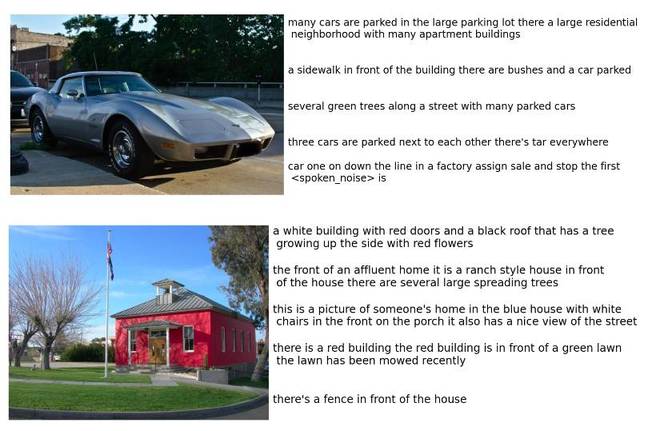
Example of captions for an image in the dataset ... Source: MIT
The model is trained to link words to relevant images, and gives a similarity scoring for each pairing. "In its simplest sense, our model is designed to calculate a similarity score for any given image and caption pair, where the score should be high if the caption is relevant to the image and low otherwise," the paper said.
During the test phase, the researchers fed the network audio recordings describing a picture in its database and it was asked to retrieve ten images that best matched the description. Out of those ten images, it would contain the correct one only 31 per cent of the time.
It's a low score, and the new method is a rudimentary way of giving computers a way of recognising words without any knowledge of text or language, but with improvement it could help speech recognition to adapt to different languages.
Mapping audio input to images isn't immediately useful, but if the system is trained on images that are associated with words from different languages, it may provide a new way to translate speech into other languages.
"The goal of this work is to try to get the machine to learn language more like the way humans do," said Glass. "The current methods that people use to train up speech recognisers are very supervised. You get an utterance, and you're told what's said. And you do this for a large body of data.
"I always emphasize that we're just taking baby steps here and have a long way to go," Glass says. "But it's an encouraging start."

Developers: Will AI run you out of your job?

AI will disrupt how developers build applications and the nature of the applications they build.

ready-for-robots.jpg

Much has been written about how artificial intelligence (AI) will put white-collar workers out of a job eventually. Will robots soon be able to do what programmers do best -- i.e., write software programs? Actually, if you are or were a developer, you've probably already written or used software programs that can generate other software programs. That's called code generation; in the past, it was done through "next" generation programming languages (such as a second-, third-, fourth-, or even fifth-generation languages), today are called low code IDEs. But also Java, C and C++ geeks have been turning high level graphical models like UML or BPML into code.
But that's not what I am talking about: I am talking about a robot (or bot) or AI software system that, if given a business requirement in natural language, can write the code to implement it -- or even come up with its own idea and write a program for it.
Don't panic! This is still science fiction, but it won't be too long before we can use AI to improve development, thanks to smarter tools that learn based on the individual developer's style and application and help write better, higher-quality code. We can see early signs of this: Microsoft's Intellisense is integrated into Visual Studio and other IDEs to improve the developer experience. HPE is working on some interesting tech previews that leverage AI and machine learning to enable systems to predict key actions for participants in the application development and testing life cycle, such as managing/refining test coverage, the propensity of a code change to disrupt/break a build, or the optimal order of user story engagement.
But AI will do much more for us in the future. How fast this happens depends on the investments and focus on solving some of the harder problems, such as "unsupervised deep learning," that firms like Google, FaceBook, Baidu and others are working on, with NLP linguists that are too researching on how to improve language comprehension by computers leveraging ML and neural networks.
But in the short term, AI will most likely help you be more productive and creative as a developer, tester, or dev team rather than making you redundant. Don't be afraid. Take advantage of this opportunity and you'll get an immediate return: It will give you more time to be more creative and to deliver more innovation -- which will help you save your job in the long term!
My recent report, How AI Will Change Software Development And Applications, shows how AI will change the way you program and build applications as well as the applications themselves. I surveyed over 25 software vendors and system integrators/consulting organizations and have been talking to a dozen or more experts in software companies about their near-future plans for leveraging AI to improve the way they build and test software. The results encouraged us to create a new stream of research that focuses on the shared ideas, concrete plans, and pilot projects and applications developed with clients.
Interestingly, our interviewees saw testing as the most popular phase of the software delivery life cycle in which to apply AI. This makes sense, as quality is of paramount importance in the age of digital acceleration; it's hard to both guarantee quality and speed to keep up with continuous delivery or the growing delivery cadence of modern development teams; and to achieve high quality it is expensive.
Firms are looking to AI both to increase test automation to unprecedented levels and test in much smarter ways, and lower the costs for it. In my recent trip to India Infosys, Wipro, TCS, IBM GBS shared interesting client case studies, and other GSIs have shown me some early accelerators
To find out how AI will change the way you program and build applications as well as the apps themselves, read my report -- the first in a series. The next report will focus on testing, given the heat around it.

Tuesday, December 6, 2016

Google Artificial Intelligence Whiz Describes Our Sci-Fi Future


A top Google researcher talks about increasingly intelligent computers.

The next time you enter a query into Google’s search engine or consult the company’s map service for directions to a movie theater, remember that a big brain is working behind the scenes to provide relevant search results and make sure you don’t get lost while driving.
Well, not a real brain per se, but the Google Brain research team. As Fortune’s Roger Parloff wrote, the Google Brain research team has created over 1,000 so-called deep learning projects that have supercharged many of Google’s products over the past few years like YouTube, translation, and photos. With deep learning, researchers can feed huge amounts of data into software systems called neural nets that learn to recognize patterns within the vast information faster than humans.
In an interview with Fortune, one of Google Brain’s co-founders and leaders, Jeff Dean, talks about cutting-edge AI research, the challenges involved, and using AI in its products. The following, done against the backdrop of the 50th annual Turing Award, an honor in computer science from the Association for Computing Machinery, has been edited for length and clarity.
What are some challenges researchers face with pushing the field of artificial intelligence?
A lot of human learning comes from unsupervised learning where you’re just sort of observing the world around you and understanding how things behave. That’s a very active area of machine-learning research, but it’s not a solved problem to the extent that supervised learning is.
So unsupervised learning refers to how one learns from observation and perception, and if computers could observe and perceive on their own that could help solve more complex problems?
Right, human vision is trained mostly by unsupervised learning. You’re a small child and you observe the world, but occasionally you get a supervised signal where someone would say, “That’s a giraffe” or “That’s a car.” And that’s your natural mental model of the world in response to that small amount of supervised data you got.
We need to use more of a combination of supervised and unsupervised learning. We’re not really there yet, in terms of how most of our machine learning systems work.
Can you explain the AI technique called reinforcement learning?
The idea behind reinforcement learning is you don’t necessarily know the actions you might take, so you explore the sequence of actions you should take by taking one that you think is a good idea and then observing how the world reacts. Like in a board game where you can react to how your opponent plays. Eventually after a whole sequence of these actions you get some sort of reward signal.
Reinforcement learning is the idea of being able to assign credit or blame to all the actions you took along the way while you were getting that reward signal. It’s really effective in some domains today.
I think where reinforcement learning has some challenges is when the action-state you may take is incredibly broad and large. A human operating in the real world might take an incredibly broad set of actions at any given moment. Whereas in a board game there’s a limited set of moves you can take, and the rules of the game constrain things a bit and the reward signal is also much clearer. You either won or lost.
Get Data Sheet, Fortune’s technology newsletter.
If my goal was to make a cup of coffee or something, there’s a whole bunch of actions I might want to take, and the reward signal is a little less clear.
But you can still break the steps down, right? For instance, while making a cup of coffee, you could learn that you didn’t fully ground the beans before they were brewed—and that it resulted in bad coffee.
Right. I think one of the things about reinforcement learning is that it tends to require exploration. So using it in the context of physical systems is somewhat hard. We are starting to try to use it in robotics. When a robot has to actually take some action, it’s limited to the number of sets of actions it can take in a given day. Whereas in computer simulations, it’s much easier to use a lot of computers and get a million examples.
Is Google incorporating reinforcement learning in the core search product?
The main place we’ve applied reinforcement learning in our core products is through collaboration between DeepMind [the AI startup Google bought in 2014] and our data center operations folks. They used reinforcement learning to set the air conditioning knobs within the data center and to achieve the same, safe cooling operations and operating conditions with much lower power usage. They were able to explore which knob settings make sense and how they reacted when you turn something this way or that way.
Through reinforcement learning they were able to discover knob settings for these 18 or however many knobs that weren’t considered by the people doing that task. People who knew about the system were like, “Oh, that’s a weird setting,” but then it turned out that it worked pretty well.
What makes a task more appropriate for incorporating reinforcement learning?
The data center scenario works well because there are not that many different actions you can take at a time. There’s like 18 knobs, you turn a knob up or down, and you’re there. The outcome is pretty measurable. You have a reward for better power usage assuming you’re operating within the appropriate margins of acceptable temperatures. From that perspective, it’s almost an ideal reinforcement learning problem.
An example of a messier reinforcement learning problem is perhaps trying to use it in what search results should I show. There’s a much broader set of search results I can show in response to different queries, and the reward signal is a little noisy. Like if a user looks at a search result and likes it or doesn’t like it, that’s not that obvious.
How would you even measure if they didn’t like a certain result?
Right. It’s a bit tricky. I think that’s an example of where reinforcement learning is maybe not quite mature enough to really operate in these incredibly unconstrained environments where the reward signals are less crisp.
What are some of the biggest challenges in applying what you’ve learned doing research to actual products people use each day?
One of the things is that a lot of machine learning solutions and research into those solutions can be reused in different domains. For example, we collaborated with our Map team on some research. They wanted to be able to read all the business names and signs that appeared in street images to understand the world better, and know if something’s a pizzeria or whatever.
It turns out that to actually find text in these images, you can train a machine learning model where you give it some example data where people have drawn circles or boxes around the text. You can actually use that to train a model to detect which pixels in the image contain text.
That turns out to be a generally useful capability, and a different part of the Map team is able to reuse that for a satellite-imagery analysis task where they wanted to find roof tops in the U.S. or around the world to estimate the location of solar panel installations on rooftops.
And then we’ve found that the same kind of model can help us on preliminary work on medical imaging problems. Now you have medical images and you’re trying to find interesting parts of those images that are clinically relevant.

Elon Musk's OpenAI and Google's DeepMind release their AI playgrounds to everyone

The first-person game levels, which are being released on GitHub, are based on the Quake III Arena game engine


Artificial intelligence developed by the likes of Google's DeepMind and Elon Musk's OpenAI is taught within the confines of game worlds – including navigating around mazes, dodging deadly cliffs, playing laser tag and flying through space.
In a mission to build a general AI capable of solving any problem put in front of it, DeepMind is open-sourcing its game code to everyone. The software and 14 levels from DeepMind Labs will be put on GitHub later this week.
And, not to be outdone, Elon Musk's own OpenAI is also releasing its own 'computer training ground' called Universe. Universe is open-source software that supports Gym; OpenAI's toolkit for testing its algorithms which help software play games, for example, using a reward scheme.

Videos of the gaming world released alongside the source code show AI agents (which are represented by large orbs) collecting pieces of fruit, walking through corridors, climbing stairs, exploring space, and navigating their way around a complex digital maze.
 Open-sourcing the software will allow AIresearchers to develop their own levels, test their own AI on the platforms and verify what the Google-owned firm has used it for. ("You could make huge mazes with keys and doors and all sorts of challenges")."The [AI] agents are wandering around in this world and there are all sorts of different objects they can see: walls, doorways, pieces of fruit and other objects they can pick up," Shane Legg, one of DeepMind's co-founders, told WIRED. "It's up to them to learn how to behave in this environment and solve the problems we can give to them."
"It's much closer to the real-world," Legg continued. "We live in a 3D environment, if we want artificial intelligence systems that can perceive the real-world; to move around in that environment; interact with it; and solve problems, this is a virtual proxy to that."
For gamers, the first-person game views may look familiar. This is because the game engine used to create it is from Quake III Arena – released 17 years ago. "The world," which has been further developed by Deepmind, "is rendered with rich science fiction-style visuals": a paper published alongside the source code says.
Within DeepMind, the Lab, which has been used for a "couple of years" and is still being developed, has been used to advance its own machine learning. The game world has helped teach AI to have a short-term memory (like navigating the London Underground), episodic memory (similar to how dogs and humans remember), image detection and navigation skills.The aged-game engine was purposefully picked. "There are advantages to using relatively old software," Legg explained. "They were designed to run on relatively low-powered computers and get quite good performance". The old engine is resource efficient and doesn't need to be run on a GPU.
Legg concluded: "Navigation brings together a number of different challenges: you may want to remember the structure of a maze and then use what you have remembered and learnt about the structure to plan your way through the maze and solve a problem."
Back in April, Elon Musk's artificial intelligence firm similarly created a 'gym' to let developers train their AI systems on games and challenges.
The open source code provides "environments" in which developers can test their AIs. These environments include 59 Atari games, with Alien, Pong, Asteroids and Pac-Man all making an appearance.
OpenAI also compiles a leaderboard of the most successful systems. Unlike traditional leaderboards, however, these won't be a list of high scores – instead, success will be based on how versatile the systems are.