Highlight

Những điều thú vị khi dùng Trí tuệ nhân tạo của Viettel

Những người dùng Internet tại Việt Nam thường lấy “chị Google” ra để… giải trí. Khi “chị” đọc văn bản hay chỉ đường cho người tham gia gi...

Thursday, September 29, 2016

Der erste von einer künstlichen Intelligenz komponierte Song ist gar nicht so übel

Wäre da nicht ein Mensch, der die Lyrics dazu geschrieben hat.
Wenn ein Computer Musik macht, ist die naheliegendeste Kritik wohl folgende: Da fehlt das Gefühl, das Menschliche. "Daddy's Car", der erste komplett von einer künstlichen Intelligenz komponierte Song, soll das Gegenteil beweisen. Auf Basis von eingespeisten Beatles-Harmoniefolgen und Songstrukturen hat eine künstliche Intelligenz das Lied zusammengestückelt. Laut seiner Erfinder von Flowmachines, einem Forscherteam vom Pariser Sony Computer Science Laboratory, soll das Programm imstande sein, jeden Stil bis hin zu verkopftem Jazz imitieren zu können.

Im Beatles-Fall klingt das Ergebnis tatsächlich ansatzweise nach den Fab Four, die Struktur überrascht mit unerwarteten Harmoniewechseln und die langgezogenen, mehrstimmigen Gesangspassagen gehen schon irgendwie in Richtung Lennon/McCartney. Man könnte der künstlichen Intelligenz also durchaus auf die Schulter klopfen.
ANZEIGE
Viel interessanter ist da der zweite veröffentlichte Song "Mr Shadow", der angeblich von amerikanischen Songwritern wie Duke Ellington, Cole Porter, George Gershwin und Irving Berlin inspiriert ist:
"Mr Shadow" klingt wie das Aufeinandertreffen eines kiffenden Autotune-Straßenhundes mit dem Produzenten der Sexy-Sport-Clips auf DSF. Von einem Duke Ellington hört man da herzlich wenig, der Refrain versucht es aber auch gar nicht erst mit billigen Referenzen: Er besteht aus einem schlichten, aber direkt ins Herz gejaulten "deadeldooooo, DEADELDOOOO" – groß!
Den klassischen Komponisten werden die Macher von Flowingmachines also in absehbarer Zeit genauso wenig ersetzen, wie die in den Achtzigern entwickelten Drummachines zum Aussterben des Schlagzeugers geführt haben.

Diese Synthetik der Drummachines allerdings, die eben gerade nicht wie ein echtes Schlagzeug klingen, hat damals zur Entstehung völlig neuer Genres wie Techno und House geführt. Im Falle der Komponisten-Computer können wir uns also vielleicht bald über das Genre "Sexy-Straßenhund-Dreampop" freuen.

Friday, September 23, 2016

Artificial Intelligence has become the next big thing – again

Android-woman

Back in 2012, a team at Google built a state-of-the-art artificial intelligence network and fed it ten million randomly selected images from YouTube. The computer churned through them, and announced that it kept finding these strange things with furry faces. It had, in other words, discovered cats.
Artificial intelligence has, all of a sudden, become the next big thing again. It is not so much sweeping across our world as seeping into it, with a combination of enormous computing power and the latest ‘deep learning’ techniques promising to give us better medical diagnoses, better devices, better recipes and better lives. Soon, it might even be able to give us new Beatles songs.
At the same time, however, we are growing increasingly alarmed about what it can — or might — do. Decades ago, Norbert Wiener, the father of cybernetics, warned:
The world of the future will be an ever more demanding struggle against the limitations of our own intelligence, not a comfortable hammock in which we can lie down to be waited upon by our robot slaves.
As fears grow about the automation of the labour market, many are asking the same question as Bertrand Russell, reviewing one of Wiener’s books back in 1951: ‘Are human beings necessary?’
Our conflicted, co-dependent relationship with our devices really took root, argues Thomas Rid in Rise of the Machines, in the second world war. Faster planes and better bombs meant that it was no longer possible for gunners just to point and shoot. To anticipate the enemy’s path, humans needed mechanical crutches: radar stations that could spot incoming targets, guns that could be automatically pointed at their predicted location, shells containing tiny radars of their own which would explode when they detected metal objects nearby. (These were arguably the most effective and certainly the least known wonder weapon of the war.)
Rid, a professor in the war studies department at King’s College London, is as good on the military stuff as you’d expect: his account of Russian attempts to hack America’s defence systems in the Clinton era is similarly definitive (and terrifying). The problem with Rise of the Machines is that the journey between these two points is more of a meander.
Wiener’s theories on human-machine interaction (he took ‘cybernetics’ from the Greek kybernan, meaning to navigate, steer, or govern) were derived from his wartime work on anti-aircraft fire. Rid attempts to trace his influence to the techno-hippies of the 1970s and 1980s, or to the writings of William Gibson. It’s all interesting stuff, but it’s hard to see what cybernetics, cyberspace and cyberwarfare have in common apart from their nebulously defined prefix. Rid’s introduction semi-acknowledges the problem, but defends itself on the grounds that this is work on myth. Sadly, it is one that is too often, in Rid’s own words, obscuring rather than clarifying.
There is a much crisper focus to Margaret A. Boden’s AI, a brief introduction to artificial intelligence (which also offers a clearer definition of cybernetics in one throwaway paragraph than Rid does in 400 pages). Sadly, those seeking to understand the modern world will probably emerge equally baffled. Boden, as an academic in the field of AI, really knows her stuff, and you get a clear understanding from her book of the various different kinds of AI, and their enduring limitations — in particular regarding the emergence of a self-aware Skynet or HAL 9000 clone that will scour us puny humans from the planet. But once she gets technical, she offers perilously little purchase for the general reader. (There are also brackets. Lots of them.)
In short, if you’re interested in learning more about our robotic soon-to-be overlords, your best bet is Thinking Machines by the British journalist Luke Dormehl. Yes, it has its flaws — a feature of Dormehl’s writing is an inability to explain that the first AI conference was in 1956 without adding that this was the year when
Elvis Presley was scandalising audiences with his hip gyrations, Marilyn Monroe married playwright Arthur Miller, and President Dwight Eisenhower authorised ‘In God we trust’ as the US national motto.
But overall, this is an accessible primer to the state of the digital art — how the field of AI grew and shrank and grew again, what the robots’ ever-increasing strengths are, and where they are still weak. He also teases out, as do Rid and Boden, the ways in which it is impossible to separate machines from their masters, how we bring our own fleshy biases to their design and work.
Forecasts of an AI takeover have been with us from the dawn of the computing age. Back in 1960, the computing pioneer Herbert Simon announced that ‘duplicating the problem-solving and information-handling capabilities of the brain is not far off; it would be surprising if it were not accomplished within the next decade’. In the 1970s, one researcher was chastised by a subordinate for his giddy prophecy about how soon robots would be picking up our socks. ‘Notice all the dates I’ve chosen were after my retirement,’ he retorted.
Today’s forecasts of an AI revolution may be similarly premature — but perhaps not. During our long dance with our artificial partners, humans and robots have moved closer and closer together, become more and more entwined. Surprisingly soon, we may find them starting to take the lead.

Google open sources image captioning model in TensorFlow


Pretty much 100 percent of my generation is obsessed with Instagram. Unfortunately, I left the platform (sorry all) back in 2015. Simple reason, I am way too indecisive about which photos to post and what pithy caption to give them.
Google TensorFlow Captioning
Provided by Google
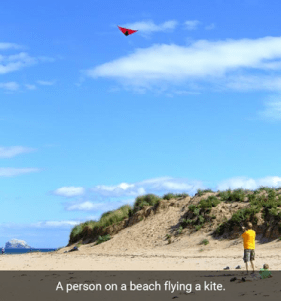
Fortunately, with ample spare time, those who share my problem can now use an image captioning model in TensorFlow to caption their photos and put an end to the pesky first-world problem. I can’t wait for the beauty on the right to start rolling in the likes with the ever-creative  “A person on a beach flying a kite.”
Jokes aside, the technology developed by research scientists on Google’s Brain Team is actually quite impressive. Google is touting a 93.9 percent accuracy rate for “Show and Tell,” the cute name Google has given the project. Previous versions fell between 89.6 percent and 91.8 percent accuracy. For any form of classification, a small change in accuracy will have a disproportionately large impact on usability.
To get to this point, the team had to train both the vision and language frameworks with captions created by real people. This prevents the system from simply naming objects in a frame. Rather than just noting sand, kite and person in the above image, the system can generate a full descriptive sentence. The key to building an accurate model is taking into account the way objects relate to one another. The man is flying the kite, it’s not just a man with a kite above him.
Google TensorFlow Image Caption
Provided by Google
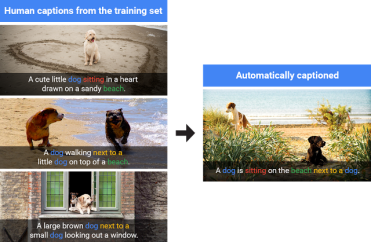
The team also notes that their model is more than just a really complex parrot that spits back entries from its training set of images. From the image on the left, you can see how patterns from a synthesis of images are combined to create original captions in previously unseen images.
Prior versions of the image captioning model took three seconds per training step on an Nvidia G20 GPU, but the version open sourced today can do the same task in a quarter of that time, or just 0.7 seconds. That means that today’s version is even more sophisticated than the version that tied for first in last year’s Microsoft COCO image captioning challenge.
Earlier this year at the Computer Vision and Pattern Recognition conference in Las Vegas, Google discussed a model they had created that could identify objects within an image and build a caption by aggregating disparate features from a training set of images captioned by humans. The key strength of this model is its ability to bridge logical gaps to connect objects with context. This is one of the features that will eventually make this technology useful for scene recognition when a computer vision system needs to differentiate from, let’s say, a person running from police and a bystander fleeing a violent scene.

Thursday, September 22, 2016

Watson, wir haben ein Problem

Künstliche Intelligenz: Unsere Arbeitswelt wird schon in wenigen Jahren eine völlig andere sein.
Lesen, schreiben, zuhören und verstehen – intelligente Maschinen können immer mehr Dinge, die bisher nur Menschen konnten. Was bedeutet das für unsere Jobs? Und für uns?

ReplyBuy brings an AI concierge to the sports and entertainment market


Whether you’re a high school student or an NFL team owner, everybody texts. ReplyBuy, a finalist in the 1st and Future competition, wants to use the text message to get you tickets for sporting events. 1st and Future is a sports-centric startup competition produced as a joint effort between the NFL, Stanford’s Graduate School of Business and TechCrunch.
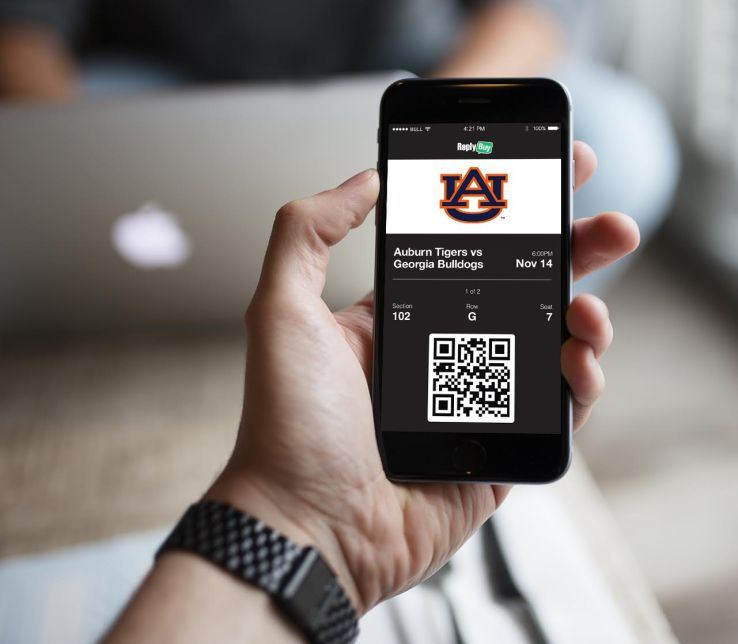
The current version of ReplyBuy works like this — the company sends a text message to all San Francisco 49ers fans; whoever replies “Buy Now” the fastest gets the tickets. Today, the company is making the platform immensely more useful with the launch of ReplyBuy.ai.
Indeed, ReplyBuy is introducing artificial intelligence to the sports and entertainment vertical. Dubbed ReplyBuy.ai, the AI is a VIP concierge service that will make it even easier for users to get their hands on tickets to major events.
Instead of just receiving text messages when tickets are available, users will now be able to send a text message with a request to buy tickets for whichever event they want; the chatbot will ask a few follow-up questions, like “how many tickets do you want?” and “what’s your price range.” From there, it will automatically buy tickets for you and deliver them instantly via text.

ReplyBuy’s client list includes several top NFL, NBA, NHL and MLS teams using the service, as well as several major universities like UCLA and the University of Arizona. You can check out the full roster of current clients on the company’s website.
ReplyBuy plans to enhance the ReplyBuy.ai experience so it does more than just buy tickets. CEO Josh Manley also tells TechCrunch that in the future, ReplyBuy.ai will be able to be leveraged not only through SMS, but can also be integrated into apps with chat capability and messaging based services like iMessage and Facebook Messenger, along with IoT devices like Amazon Echo and others.
Since the company was founded in 2011, they’ve raised $2.65M. The company was recently nominated for the “Best in Mobile Fan Experience” award held by the Sports Business Awards, and also for the “Move to Mobile” and “Product Innovation” categories at the Ticketing Technology Awards.
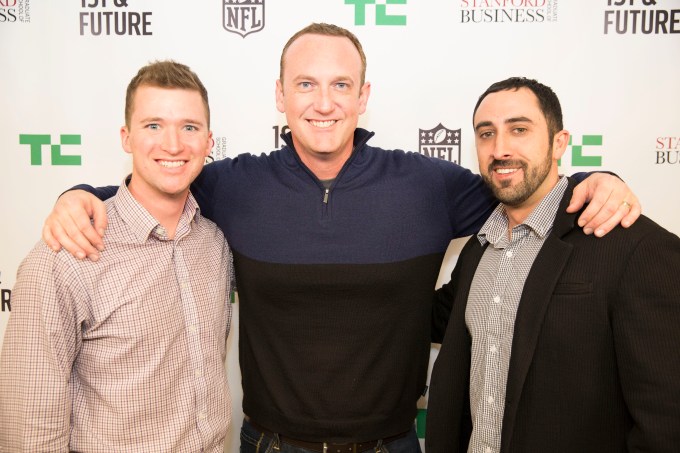
1st & Future event at Stanford University in Palo Alto, CA on February 6, 2016. Photo by Max Morse for TechCrunch
We’re thrilled to see former TechCrunch event alums making splashes in their respective industries, and we can’t wait to see what the next batch of startups have in store for us in the Startup Battlefield at Disrupt London 2016. Applications to participate in the Battlefield are open now through October 5, so as long as your company meets the eligibility criteria, you can apply here to participate in the Battlefield.
Disrupt London 2016 takes place December 5-6 at London’s Copper Box Arena. We can’t wait to see all you fabulous innovators, investors and tech enthusiasts at the show.

Wednesday, September 21, 2016

DeepMind wants its healthcare AI to charge by results — but first it needs your data

DeepMind wants its healthcare AI to charge by results — but first it needs your data
Mark your Google calendars because from today ‘Don’t be evil’ rides again, via the DeepMind AI division of the Alphabet ad giant, as a Hippocratic assurance to ‘Do no harm’. 
It’s no small irony that DeepMind’s new mantra for its healthcare push, voiced by co-founder Mustafa Suleyman at an outreach event today for patients to hear what the Google-owned company wants to build with U.K. National Health Service data, is uncomfortably close to its old one — i.e. the one that embarrassingly fell out of favor.
Suleyman cited the Hippocratic oath when discussing his takeaways from patient feedback on the company’s plans.
“[Do no harm] has to be a mantra we repeat and becomes an inherent part of our process,” he said towards the end of the three hour discussion session which was live streamed onYouTube (with a call for comments via a #DMHpatients Twitter hashtag).
“And [do no harm] should be the first measure of success before any deployment or before we attempt to demonstrate any utility and patient benefit,” he added.
After taking questions and listening to views from the small group of patients, health professionals and members of the public selected by the company to be in the audience, Suleyman flagged other takeaways. One of which was the need to widen access to the patient engagement channel DeepMind has now opened up.
He conceded it was unfortunate the event had been held in Google’s shiny, central London offices.
“As you say this is a fancy, intimidating building and I’m sorry for that, in some ways, it’s a shame that that’s the tone. I really agree with you that we have to find other spaces, community spaces that are more accessible to a more diverse group of people,” he said.
“As we formalize the process [of listening to patients] we want to make sure that there are other people being paid around the table and patients’ contributions should also be paid, and we’ll make sure that that’s the case. Potentially we should be thinking about how to run sessions like these on the weekends or in the evenings, when different stakeholders might have more time to get involved,” he added.
Alphabet’s AI division also said today it is intending to “define” what it dubs a “patient involvement strategy” by 2017.
Although DeepMind kicked off data-sharing collaborations with the NHS last fall — inking a wide-ranging data-sharing agreement with London’s Royal Free NHS Trust in September 2015 — and only publicly revealing the DeepMind Health initiative this February, two months after beginning hospital user tests of one of the apps it’s co-developing with the Royal Free… So it’s hard not to see its attitude towards patient engagement and involvement as something of an afterthought up to now.
Controversy and scrutiny 
It also looks like a response to the controversy generated earlier this year by DeepMind’s first publicly announced collaboration with an NHS Trust (the Royal Free) — given that criticism of that project (Streams, an app for identifying acute kidney injury) has focused on how much patient identifiable data the Google-owned company is being given access to power the app, without patient knowledge, let alone consultation or consent. (DeepMind and the Royal Free maintain they do not need patient consent to share the data in that instance as they say the app is for direct patient care — a point the company now reiterates on its website, in a section labeled ‘Information Governance‘.)
The UK’s data protection watchdog, the ICO, is investigating complaints about the Streams app. The National Data Guardian, which is tasked with ensuring citizens’ health data is safeguarded and used properly, is also taking a closer look at how data is being shared. Streams was also not registered as a medical device prior to being tested in hospitals — but should have been, according to the MHRA regulatory body. So DeepMind Health’s modus operandi has already rocked a fair few boats — even as Suleyman was at pains to stress it’s “very early days” for DeepMind Health in his public comments today.
Tellingly the Google-owned company also now has a section of its Health website labeled ‘For Patients‘, where it describes its intention to create “meaningful patient involvement” and claims it is “incorporating patient and public involvement (PPI) at every stage of our projects”. (Although here, again, it notes another future intention: to create a patient advisory group to “contribute more extensively to our projects” — suggesting it could have done much more to involve patients in its first wave of NHS projects and research partnerships.)
“What we’re really doing today is to try and invite people openly to come and help us design the mechanism of interaction,” said Suleyman, summing up DeepMind’s intention for the outreach event. “Many people in this room have much more expertise and experience than we do and we recognize that we have a lot to learn here, and so today I think is an opportunity for us to learn. We’re really grateful for people’s time. We recognize that it’s valuable and we really think this is potentially an opportunity to do this the right way.”
He did not directly reference the Streams app data-sharing controversy, although the entire session was structured to illustrate (as DeepMind views it) the benefits of sharing health data for patients and health outcomes — and thus create a strong narrative to implicitly defend its actions — with much talk of the economic squeeze on the publicly funded NHS and the need to move towards earlier diagnosis of conditions to save resources as well as lives. Tl;dr: DeepMind’s sales pitch to grease the NHS health data funnel is that AI could automate efficiency savings for a chronically cash-strapped NHS. Ergo: you can’t afford not to give us your data!
And while Google’s podium included speakers who do not work directly for Alphabet, all speakers at the event were selected by the company to speak, so unsurprisingly aligned with its views. For example, we heard from Graham Silk of health data sharing advocacy group, Empower: Data4Health, rather than — say — Phil Booth from health data privacy advocacy groupMedConfidential, which has been critical of DeepMind’s handling of NHS data.

Microsoft wants to crack the cancer code using artificial intelligence

Cancer is like a computer virus and can be ‘solved’ by cracking the code, according to Microsoft. The computer software company says its researchers are using artificial intelligence in a new healthcare initiative to target cancerous cells and eliminate the disease.
One of the projects within this new healthcare enterprise involves utilizing machine learning and natural language processing to help lead researchers sift through all the research data available and come up with a treatment plan for individual cancer patients.
IBM is working on something similar using a program called Watson Oncology, which analyzes patient health info against research data.
Other Microsoft healthcare initiatives involve computer vision in radiology to note the progress of tumors over time and a project which Microsoft refers to as its “moonshot” aims to program biology like we program computers using code. The researchers plan to discover how to reprogram our cells to fix what our immune system hasn’t been able to figure out just yet.
Microsoft says its investment in cloud computing is a “natural fit” for this type of project and plans to invest further in ways to provide these types of tools to its customers.
“If the computers of the future are not going to be made just in silicon but might be made in living matter, it behooves us to make sure we understand what it means to program on those computers,” Microsoft exec Jeanette M. Wing said.
Indeed, with all the research data available, the Microsoft project, like many others in the healthcare machine learning space — including in cancer cure discovery — could help speed up medical discovery for this debilitating disease.