Artificial intelligence received $974m of funding as of June 2016 and this figure will only rise with the news that 2016 saw more AI patent applications than ever before
62 per cent of organisations will be using Artificial Intelligence (AI) by 2018 according to Narrative Science. At present, predictive analytics is the most used form of AI in enterprise and companies are focusing on innovation, patenting their AI developments at a faster rate than ever before.
Join us as we explore the rise of artificial intelligence in six charts including the top investors in AI and the most used AI enterprise solutions.
As of June 2016, artificial intelligence received $974m of funding. This year’s funding is set to surpass 2015’s total and CB Insights suggests that 200 AI-focused companies have raised nearly $1.5 billion in equity funding.
AI isn’t limited to the business sphere, in fact the personal robot market, including ‘care-bots’, could reach $17.4bn by 2020. Care-bots could prove to be a fantastic solution as the world’s populations see an exponential rise in elderly people. Japan is leading the way with a third of government budget on robots devoted to the elderly.
Fujitsu holds the most Artificial Intelligence patents, its human-centric AI Zinrai incorporates sensory-media technologies that can process people’s feelings, knowledge processing that can provide medical decision-making support and mathematic technology that is able to assist in mitigating air traffic.
IBM comes in close second with 88 AI patents. IBM inventors have developed new technologies that can help machines learn, reason, and process diverse data types, for example, IBM Research’s China lab patented a system that helps machines interpret emotion-laden words so they can converse in a more natural manner.
Accel, a venture capital firm headquartered in Palo Alto, announced a $500 million fund for early stage companies and $1.5billion fund for late stage businesses. Of their nine areas of focus for the future, Artificial Intelligence topped the list of priorities.
New Enterprise Associates, also a worldwide venture capital firm, is the second top investor in Artificial Intelligence. The firm has invested in WellTok’s CafeWell.com website which combines social networking technology with knowledge of healthcare, making recommendations based on health goals allowing users to take control of their wellbeing.
The most AI based venture capital deals were in deep learning/machine learning. Naveen Rao, founder and Chief Executive of Nervana Systems explains, “the method allows computers to process tasks through ‘neural networks’, systems that mimic the structure of the human brain in order to learn, improve and, in the case of AlphaGo, become capable of decision-making that resembles human intuition more than it does brute computation.”
Programs that rely on deep learning are commonplace, for example Facebook’s newsfeed relies on deep learning to organise the news that is of most relevance to you personally and auto-tagging also uses this type of AI.
Narrative Science’s survey of over 200 CEOs, CIOs, CTOs and data scientists revealed that voice recognition and response solutions are the most widely used AI solutions in business followed by machine-learning.
Virtual personal assistants were used by 15 per cent of those surveyed. Virtual assistants, a standard feature on smartphones including Google Now and Apple Siri, are a one-stop solutions provider for business leaders and consumers alike with the ability to set up meetings, answer web searches and suggest the least congested travel routes.
In Saarbrücken arbeiten deutsche Forscher an der Welt von morgen: Sie bringen Rechnern das Denken bei. Seit 20 Jahren treiben sie das „Deep Learning“ voran – inzwischen auch für Giganten wie Google.
Dieses Auto, gelb und kaum größer als ein Daumennagel, ist für Wolfgang Wahlster der Beweis, welch gewaltige Revolution er da mit seinen Leuten angezettelt hat. Das Auto fährt wie von einem Geist gelenkt, ohne Fahrer, es nimmt präzise jede Kurve, bremst vor jeder Kehre, weicht Hindernissen aus. Wahlster schaut auf einen Bildschirm, der vor ihm steht, und sagt: „Noch vor wenigen Jahren wäre das unmöglich gewesen.“
Ein Tempolimit einhalten, nur bei Grün fahren, das konnten auch gewöhnliche Computerprogramme, schon vor Jahren. Aber denken, das konnten sie nicht. Das war Science-Fiction, etwas für Spinner oder Hollywood-Regisseure, vielleicht noch für Programmierer oder Nerds, etwas für Männer wie Wahlster.
Jetzt gibt es Hochleistungsrechner, die irrwitzig viele Daten in ein Abbild der Wirklichkeit verwandeln können. Und jetzt lernen Computer zu denken, lernen antrainierte Reflexe des Menschen nachzuahmen, etwa im Straßenverkehr. Das kleine gelbe Auto auf dem Bildschirm vor ihm belegt das.
„Dafür“, sagt Wahlster, „brauchen Sie künstliche Intelligenz.“
Deutsche wurden Stars der internationalen IT-Branche
Was er nicht sagt, weil der 63-Jährige Forscher mit der randlosen Brille, der mehr wie ein deutscher Mittelständler und weniger wie ein Supernerd wirkt, ein eher bescheidener Mensch ist: Dass er und seine Mitarbeiter diese weltweite Revolution mit ins Werk gesetzt haben.
Sie haben überlegt, geforscht, entwickelt, sie haben dazu beigetragen, dass Computer heute Autos lenken können, dass Roboter in Fabrikhallen selbst ihre Wartung planen und Computer Bilder in sozialen Netzwerken für Blinde übersetzen können oder sich mit Nutzern unterhalten können, als wären sie Menschen. So wurden Wahlster, Chef des Deutschen Forschungszentrums für Künstliche Intelligenz(DFKI) in Saarbrücken, und seine Leute zu Stars der internationalen IT-Branche.
Wolfgang Wahlster ist Chef des Deutschen Forschungszentrums für Künstliche Intelligenz (DFKI)
Quelle: DFKI)
Internet, Computer, das verbinden die Leute meist mit dem Silicon Valley. Dort wurden aus kleinen Firmen Milliardenkonzerne, die heute fast schon so etwas wie Weltmächte sind: Amazon, Google, Facebook, Apple. In Deutschland hat die Internetrevolution keine Internet-Giganten hervorgebracht.
Deutsche Wissenschaftler gelten als gut in der Grundlagenforschung, doch das Geld mit diesem Wissen verdienen fast immer die anderen, vor allem die Amerikaner. So dachte man. Und nun ist da ein deutsches Institut, das so viele Ideen hat, wie man das bisherige Wissen über künstliche Intelligenz im Alltag nutzen kann. Und wie man damit Geld verdient.
Google hat Millionen Euro in das DFKI investiert
Plötzlich hat ein Konzern wie Google das DFKI entdeckt. Die Chefs wollten Partner von Wahlsters Forschungs-Unternehmen werden, das wollten sie in Deutschland bisher nie. Google hat dafür Millionen Euro in das DFKI investiert und ist nun der erste US-Konzern unter den 17 Unternehmens-Partnern.
Dann, im Mai, kam ein weiterer Riese: VW. Auch er will mitmachen. Auch er steckt nun Geld in die DFKI-Forschung und bekommt dafür einen Sitz im Aufsichtsrat, wie Google.
Es ist ein deutsches Märchen, das denkt auch Wahlster manchmal. Es beginnt im Jahr 1988, als der Informatikprofessor an der Universität des Saarlandes gleich drei Landesregierungen vom Potenzial der künstlichen Intelligenz überzeugen kann – zu einem Zeitpunkt, als die Technologie noch völlig ohne praktischen Nutzen ist, da damalige Computertechnik auf Basis von Siemens-Großrechnern zur Datenanalyse Tage oder Wochen benötigt.
Neuronale Netze bereiteten den Weg
Drei kleine Bundesländer, Rheinland-Pfalz, Bremen und das Saarland, gründen damals zusammen mit mittelständischen Firmen ein Institut für Computerforschung. Es soll an zwei Standorten eine Niederlassung haben: in Kaiserslautern und Saarbrücken.
28 Jahre später hat das DFKI mehr als 800 Mitarbeiter und das richtige Gespür. Wahlster und seine Kollegen experimentieren schon früh mit einer Technologie, die sich im Nachhinein als der Wegbereiter zu intelligenten Computern erweist: neuronale Netze. Sie wollen damit Spracherkennung ermöglichen.
Doch die Technologie, die sie erforschen, kann viel mehr: „Mehrschichtige neuronale Netze sind eine Grundlage für selbstlernende KI-Programme, die aktuell im Strategiespiel Go siegen, Bildinhalte erkennen, Sprache verstehen oder in sozialen Netzwerken Emotionen klassifizieren“, sagt Wahlster.
Und dann ging alles schnell.
Dann sagte in Amerika ein Mann, dass die Autos, die seine Firma Tesla baute, künftig ohne Fahrer fahren würden. Dann begannen einige Firmen, die lernenden Computer in ihren Fabrikhallen, im Marketing oder im Krankenhaus einzusetzen. Dort planen sie die eigene Wartung, finden unzufriedene Kunden in sozialen Netzwerken oder durchsuchen Krankenakten von Millionen Krebspatienten auf Hinweise für Heilmittel.
Und plötzlich ist, was eben noch als Spinnerei galt, der Wettbewerbsvorteil im globalen Kampf um Marktanteile, weit über die IT-Wirtschaft und die Autobranche hinaus. Wahlster und seine Leuten sind mittendrin, bereit für den Erfolg.
VW will Forschung der künstlichen Intelligenz voranbringen
„Künstliche Intelligenz ist eine Schlüsseltechnologie für das autonome Fahren und damit eine Investition in unsere Zukunft“, sagte Volkswagen-Chef Matthias Müller, nachdem er sich beim DFKI eingekauft hatte. „Wir wollen die KI-Forschung in der Autobranche und darüber hinaus voranbringen.“
Wahlster und seine Forscher haben zum Beispiel in Kaiserslautern mit dem US-Traktorhersteller John Deere den Prototyp einer Fabrik entwickelt, die per künstlicher Intelligenz gesteuert wird: Roboter optimieren selbstständig die Produktion, Arbeiter bekommen Entscheidungshilfen von einer künstlichen Intelligenz.
Dafür müssen Hochleistungsrechner mit Daten umgehen können, die völlig unstrukturiert sind: Sensordaten von Maschinen, Wetterberichte, Spracheingaben von Arbeitern in der Werkhalle oder Kundenanfragen in sozialen Netzwerken. Gewöhnliche Computerprogramme können das nicht. Sie basieren meist auf sogenannten Wenn-dann-Beziehungen: „Wenn die Ampel rot ist, muss ich anhalten – das lässt sich leicht programmieren“, erklärt Damian Borth, Leiter des Kompetenzzentrums „Deep Learning“ in der DFKI-Filiale in Kaiserslautern.
Borth forscht daran, wie künstliche Intelligenz die reale Welt sehen und verstehen kann. Seine Lern-Algorithmen sollen künftig etwa Fußgänger auf der Straße vor dem Auto erkennen oder den emotionalen Inhalt von Bildern erschließen.
„Deep Learning“ wurde reif für den praktischen Einsatz
Diese Programme sind so komplex, dass ein Mensch sie nicht von Hand schreiben kann. Daher werden Computer künftig für ihre Aufgaben trainiert. Damit ändert sich die Kunst des Programmierens grundlegend.
Künstliche Intelligenz sucht in Daten nach Mustern, die sie bereits kennt. „Diese Mustererkennung lässt sich nicht einfach programmieren“, erklärt Borth. „Vielmehr muss der Computer anhand von Trainings-Datensätzen, die wir bereits einmal vorsortiert haben, lernen und seine Lernergebnisse mit unserer Sortierarbeit abgleichen und überprüfen.“
Dazu setzen die Forscher auf neuronale Netze – hintereinander geschaltete mathematische Filter, die die Daten durchsieben und so Strukturen erkennen. Die künstliche Intelligenz lernt, indem sie Datenwerte immer wieder in die mathematischen Gleichungen einer Filterschicht einsetzt, durchrechnet und ausprobiert, mit welcher Gewichtung die Rechenergebnisse in die Gleichungen des nächsten Filters eingehen soll.
Intelligente Assistenten sollen mit dem Nutzer in einen echten Dialog treten
Quelle: DFKI Saarbrücken
Wenn ein Netz aus Dutzenden hintereinander durchgerechneten Filtern bei der Analyse eines Hundebildes anschließend das Ergebnis „Hund“ ausspuckt, wird die Gewichtung beibehalten, andernfalls verworfen. Je mehr Bilder mit bekannten Inhalten zur Kontrolle zur Verfügung stehen, desto genauer kann ein neuronales Netz trainiert werden.
Diese Technik bezeichnen die Forscher als „Deep Learning“. Bekannt ist sie bereits seit den 80er-Jahren, doch fordert das Training neuronaler Netze immense Rechenleistung – deswegen galten sie bis vor wenigen Jahren als in der Praxis unanwendbar.
2012 jedoch kamen verschiedene Forschungsteams weltweit gleichzeitig auf die Idee, moderne 3-D-Grafikkarten des Herstellers nVidia für das Training einzusetzen: Die Matrizen-Mathematik hinter den neuronalen Netzen ist relativ einfach, muss aber milliardenfach wiederholt gerechnet werden – damit gleicht sie den Formeln hinter der Simulation von 3-D-Welten in Spielen. Auf diese Weise war das Training der Computer plötzlich um mehrere Potenzen schneller möglich, die Technik reif für den praktischen Einsatz.
Der Computer erkennt Emotionen, er hat einen Geschmack
Wahlster und seine Forscher am DFKI setzen bereits seit den frühen 90er-Jahren auf neuronale Netze – damals programmierten sie entgegen aller Unkenrufen aus der Forschergemeinschaft die Spracherkennung „Verbmobil“ auf Basis der Technik. Heute bringt ihre frühe Expertise in der Schlüsseltechnik den entscheidenden Vorsprung, der die US-Firmen anlockt.
Nvidia schenkte den DFKI-Forschern Ende September als ersten Forschern in Europa einen DGX1-Supercomputer mit den neuesten Chips des Unternehmens: „Die besten KI-Forschungseinrichtungen sollen über die beste Technologie verfügen“, kommentiert Chef Jen-Hsun Huang bei der Übergabe in Amsterdam - auch sein Konzern hofft auf neue Erkenntnisse aus dem Austausch mit den DFKI-Forschern.
Wie gut die künstliche Intelligenz des DFKI bereits die reale Welt wahrnehmen kann, demonstriert Borth in seinem Labor in Saarbrücken anhand von Videomaterial aus dem Fotodienst Flickr: Während auf seinem Bildschirm ein Video läuft, kommentiert der Computer in Echtzeit, was er sieht.
Er schreibt in irrwitzigem Tempo auf den Schirm: „Schöne Straße“, „düstere Stadt“, „stürmisches Meer“, „sonnige Stadt“. Der Computer erkennt Emotionen in den Bildern, er hat einen Geschmack. Er hat es gelernt. Die Computer-Flüsterer haben es ihm beigebracht.
Assistenten auf Pixel-Smartphones treten in einen Dialog
Es sind solche Dinge, die das DFKI für Giganten wie Google so interessant machen. Wer erkennen kann, was genau die Nutzer der Tech-Konzerne in deren Diensten und sozialen Netzwerken veröffentlichen, der kann individuell darauf eingehen – und etwa passende Werbung zu fröhliche Hundebildern der Nutzer stellen oder Hass-Postings automatisch finden und löschen.
Google setzt auf seinen neuesten, im Oktober herausgebrachten Pixel-Smartphoneseinen intelligenten Assistenten ein, der den Nutzer als allwissende Stimme durch den Alltag begleitet – aktuell auf dem Smartphone, später im Auto, über intelligente Lautsprecher im Haushalt, überall. Das System soll nicht nur programmierte Antworten beherrschen, sondern mit dem Nutzer in einen echten Dialog treten.
Das ist nur möglich, wenn der Assistent auch emotionale Inhalte oder Bezüge auf frühere Gespräche erkennt. „Der Assistent lernt mit jedem Gespräch dazu, und jeder Nutzer baut mit jeder neuen Anfrage sein persönliches Google“, sagt Google-Vorstandschef Sundar Pichai. Damit wird jeder Nutzer künftig zum Trainer seiner persönlichen künstlichen Intelligenz.
AI, like all software, isn’t immune to being hacked. In recent months, security researchers have shown that machine learning algorithms can be reverse-engineered and made to expose user data, like personal photos or health data.
So how can we protect that information? New research from OpenAI and Google shows a way to build AI that never sees personal data, but is able to function as if it had.
Ian Goodfellow, a researcher at OpenAI, compares the system to medical school.
“The doctors who teach in medical school have learned everything they know from decades of experience working with specific individual people, and as a side effect they know a lot of private medical histories,” Goodfellow says. “But they can show the student how to practice medicine without divulging all of that history.”
The “student” algorithm, which will be exposed to the world, learns to mimic decisions of its teachers through millions of simulated decisions, but doesn’t have any of the underlying information used to inform the teacher algorithms. The teachers exist only to teach the student—they never see the light of day. The student algorithm also learns from nonsensitive, public data to fine tune results and further obscure the teachers’ data points. OpenAI and Google’s work builds on previous research that taught a student algorithm using multiple teacher algorithms, but makes the process faster and less reliant on teachers, meaning more secure. They have also released the code for others to adapt their system.
What makes reverse-engineering the algorithm even harder is the fact that there’s not just one teacher. In tests, researchers trained up to 250 teachers for one student algorithm, meaning the student doesn’t rely on any one sensitive data point, but an aggregate of information. Even if the AI was reverse-engineered, the research claims, an attacker couldn’t get any information from it.
Goodfellow’s medical school analogy works well because this system could be especially beneficial in developing medical AI by crowdsourcing information across hospitals, while keeping patient records private. An algorithm could learn from each individual hospital’s data, like radiology scans or patient data, and a student AI could automatically learn from the network of hospitals.
Companies like Google could also use this technology to learn from their users’ photos, without ever having to see them. Now, AI is trained on each user’s photos, but that AI is limited to the user’s account. A technique similar to this research could set each user’s AI as a teacher, to train a much more accurate student for Google’s Photos app, which automatically recognizes faces and objects.
This approach is a kind of differential privacy, which seeks to keep individual user information safe when it’s in a large database. For instance, anonymizing patient data in hospitals is a weaker form of differential privacy.
“Differential privacy addresses the paradox of learning nothing about an individual while learning useful information about a population,” write Cynthia Dwork of Microsoft Research and Aaron Roth of University of Pennsylvania in their book on the subject.
This is the tightrope that differential privacy walks: Accuracy against privacy. The better an algorithm mimics its teacher, the higher the possibility it can betray its teacher’s data.
“All the research in this space explores a tension between privacy and utility, as more privacy means utility goes down,” says Thomas Ristenpart, a machine learning security researcher, in an email to Quartz.
Despite this tradeoff, Goodfellow says they’ve gotten the student AI to perform within 2% of the teachers, down from 5% of the previous state of the art.
Dự đoán tương lai là một việc đầy thách thức và gần như không có gì đảm bảo được mức độ chính xác, nhưng ít nhất khi nói đến những tiến bộ về mặt công nghệ, các chuyên gia làm việc tại cơ quan nghiên cứu của Lầu Năm Góc là những người có thể cho chúng ra biết thông tin tốt nhất.
Được thành lập vào năm 1958, DARPA (Defense Advanced Research Project Agency – Cơ quan nghiên cứu các dự án phòng thủ tiên tiến của Mỹ) là cơ quan đứng sau nhiều sáng kiến công nghệ quan trọng trong quân đội, và nhiều trong số đó đã được đưa vào đời sống hàng ngày của người dân. Rất nhiều thứ mà bạn sử dụng mỗi ngày, ví dụ như công nghệ robot tiên tiến, hệ thống định vị, và cả Internet đều xuất phát từ DARPA.
Vậy theo như các chuyên gia tại đây, thế giới vào năm 2045 sẽ như thế nào?
Có khả năng rất cao là robot và công nghệ trí tuệ nhân tạo sẽ đi vào rất nhiều ngành công nghiệp quan trọng và thay thế một số vị trí của con người, những chiếc drone sẽ chuyển từ mục đích quân sự sang có mặt trên thị trường dân dụng, và xe tự hành sẽ giúp các chuyến đi của bạn trở nên thoải mái hơn.
Nhưng các nhà khoa học tại DARPA có những ý tưởng “cao siêu” hơn rất nhiều. Trong video “Forward to the Future” được quay vào năm ngoái, ba nhà nghiên cứu đã dự đoán những gì họ cho là có thể xảy ra trong 30 năm tới.
Tiến sĩ Justin Sanchez, một nhà thần kinh học và là giám đốc của văn phòng Công nghệ Sinh học DARPA, tin rằng trong tương lai, chúng ta có thể kiểm soát các thứ chỉ đơn giản bằng các dùng ý nghĩ của mình.
“Hãy tưởng tượng một thế giới mà bạn có thể sử dụng suy nghĩ của mình để kiểm soát môi trường xung quanh”, Sanchez nói.
“Hãy nghĩ về chuyện mình có thể điều khiển nhiều thứ trong nhà chỉ bằng tín hiệu não bộ, hay có thể giao tiếp với bạn bè và gia đình chỉ bằng cách sử dụng hoạt động thần kinh từ não bộ của bạn”.
Theo Sanchez, DARPA đang nghiên cứu mảng công nghệ thần kinh và có thể giúp những điều nói trên thành sự thật. Hiện tại, đã có một số ví dụ cho những công nghệ thần kinh tương lai như cấy ghép não để kiểm soát tay giả.
Chỉ cách đây không lâu, DARPA đã thử nghiệm công nghệ tuyệt vời này lần đầu tiên và giúp cho một người bị liệt có lại được xúc giác của mình thông qua việc cấy ghép não, người đàn ông này đã cho biết rằng cảm giác “như chính bàn tay mình được chạm vào”
Trong tương lai, không chỉ có cấy ghép não, mà nhiều thứ thú vị khác có thể thay đổi môi trường sống xung quanh chúng ta, Stefanie Tompkins, một nhà địa chất học và giám đốc Văn phòng Khoa hoc Quốc phòng của DARPA cho biết.
Tompkins nghĩ rằng chúng ta có thể xây được những tòa nhà cực kỳ cứng cáp như đồng thời cũng rất nhẹ. Như một tòa nhà chọc trời vững chắc như sắt thép nhưng lại nhẹ như sợi carbon.
“Trong 30 tới, tôi có thể tưởng tượng ra một thế giới mà chúng ta không thể phân biệt được các vật chất xung quanh mình nữa”, bà cho biết.
“Tôi nghĩ trong năm 2045 chúng ta sẽ thành lập những mối quan hệ rất khác biệt với các cỗ máy xung quanh mình”, Pam Melroy, một kỹ sư hàng không vũ trụ, cựu phi hành gia và giờ đây đang là một phó giám đốc tại Văn phòng Kỹ thuật Chiến lược của DARPA, cho biết.
“Tôi cho rằng chúng ta sẽ đi đến thời đại mà mình có thể chỉ cần nói hoặc nhấn một nút để tương tác với một cỗ mày và hoàn tất công việc một cách thông minh hơn, thay vì dùng bàn phím hay hệ thống nhận dạng giọng nói thô sơ”.
Cô nói thêm: “Ví dụ, hiện tai, để chuẩn bị hạ cánh một máy bay có rất nhiều bước phải mà bạn phải sẵn sàng, từ chuyển hướng, thoát chế độ hành trình, thiết lập các bộ phận. Tất cả các bước phải được thực hiện đúng trình tự”.
Thay vào đó, Melroy cho rằng việc hạ cánh máy bay trong tương lai chỉ đơn giản là phi công nói với hệ thống trợ lái: “Chuẩn bị hạ cánh”.
Trong năm 2045, phi công chỉ cần nói vài từ đó và máy tính sẽ hiểu những bước phức tạp mà nó cần làm để thực hiện tác vụ.
Hoặc thậm chí, trong những máy bay thông minh, ngay cả phi công cũng không cần thiết nữa.
“Thế giới của chúng ta sẽ đầy những ví dụ về việc ta có thể giao tiếp trực tiếp ý định của mình (với trí thông minh nhân tạo) và có những kết quả rất phức tạp thông qua việc phối hợp cùng nhau”, cô nói.
It took less than 5 mins for me to activate and transfer money from my China Merchant’s Bank account to a friend.
Using facial recognition, the smartphone app directed me to tilt my head, blink my eyes and hold my face still to authenticate the transfer.
I was impressed.
Facial recognition is gaining traction at a startling pace in China. Real-world applications already range from verifying Uber drivers toidentifying people seeking to withdraw cash from an ATM without a debt card. Chinese startups in this space have attracted serious funding: Face++ was most recently valued at $1B.
Why is China starting to lead in this space?
Data availability. As machine learning algorithms become more and more commoditized, access to huge volumes of training data is starting to become the core competitive advantage. One instantiation of this can be seen in the Face++ / Meitu partnership, through which Face++ gained access to Meitu’s 850M user-strong dataset. Other Chinese AI companies are also finding their way to get into banks, telcos, mobile phones etc. Chinese users have different notions of and expectations for privacy; this is something domestic Chinese companies have been capitalizing on with little resembling the backlash we would expect in the US. Word on the street is that some companies even sell phone conversations in different accents to train speech recognition software.
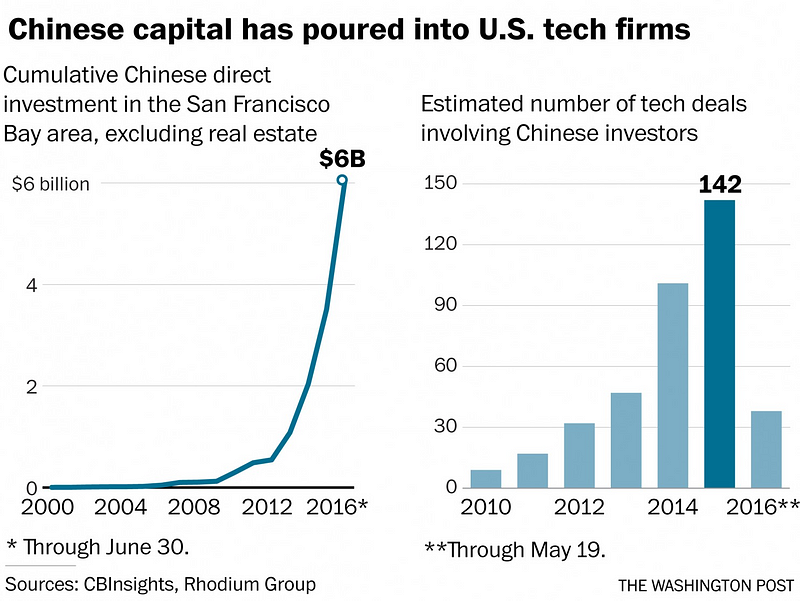
Cash money. Some Chinese investors are focused on near-term financial return when investing but many are looking for a China angle. Datavisor, a Silicon Valley software company that analyzes anomalous security patterns, has raised a significant amount from a Chinese investor and signed both American clients like Yelp and Chinese clients like Momo (NASDAQ:MOMO). The magnitude of Chinese capital being poured into AI startups in the Valley is deeply under-appreciated today. Some investments have already started to result in collaborations or JV that benefit both sides. The JV between JD.com (NASDAQ: JD) and ZestFinance, for example, will leverage ZestFinance’s machine learning-based credit-decisioning technology and JD.com’s reservoir of consumer data to provide credit risk evaluation services to companies in China.
On the M&A side, Chinese companies have already set a record for outbound M&A this year. Many are still actively looking to acquire AI companies such as speech recognition (also VR, AR companies etc.).
3. No incumbent systems and processes. Modern financial systems and instruments came to China late. It was only in the early 2000s that credit cards became somewhat common; even then, due to the lack of credit histories, users were made to deposit large amounts of money to gain access to credit. When I got my first “credit card” in 2004, I had to deposit $800 in order to spend $800. Today, Chinese lenders work with startups that provide not only US-style credit bureau histories but also richer data such as a borrower’s e-commerce purchase history, social media reputation, and so forth. The resulting credit models are significantly more sophisticated than those in the US. Whereas it will probably be a long time before the American credit system will begin mining rich user data for credit purposes, Chinese systems are leapfrogging into the 21st century.
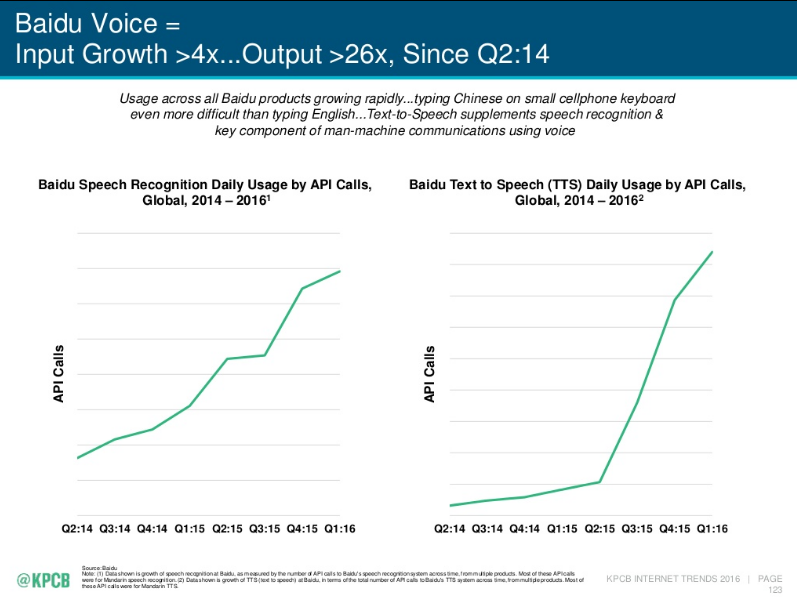
4. Access to talent. China traditionally has strong math training which has already generated a large number of data scientists domestically. In addition to hoovering up US-trained computer science PhD returnees like Megatron on any given Sunday, most major tech companies have set up serious R&D operations in the Valley. Baidu has a team of ML scientists focusing on speech recognition under the leadership of Andrew Ng. They’ve made significant progress in speech and have even begun to approach Google as evidenced by the growth of API call frequency and the accuracy of speech recognition, see below two charts (source).
Source: Mary Meeker report 2016As a whole, the Chinese tech development landscape still lags Silicon Valley today. But, if companies like DJI and Tencent (WeChat, read more about it here) are any indication, the momentum may start to tilt more heavily towards China in the years ahead. AI is one of the areas I’m keeping a close eye on.
Originally published on Medium through Startupgrind
Công ty phát triển phần mềm Trí tuệ nhân tạo cá nhân Alt Inc (Nhật Bản) đang chuẩn bị xây dựng Trung tâm nghiên cứu và phát triển Trí tuệ nhân tạo với quy mô lớn bậc nhất châu Á tại Hà Nội, Việt Nam.
Mục tiêu trước mắt của Alt Inc là hợp tác với các nhà nghiên cứu trí tuệ nhân tạo ở Việt Nam và tuyển dụng các kỹ sư phần mềm trí tuệ nhân tạo người Việt Nam từ nước ngoài về làm việc tại Hà Nội nhằm nghiên cứu và phát triển hệ thống trí tuệ nhân tạo cá nhân (Personalized Artificial Intelligence) Al+.
Để thúc đẩy quá trình hình thành và phát triển chi nhánh nghiên cứu trí tuệ nhân tạo của Alt Inc tại Việt Nam nói riêng và châu Á nói chung, Alt Inc đã mời tiến sĩ Nguyễn Tuấn Đức về làm việc và chỉ đạo nghiên cứu tại văn phòng Hà Nội.
TS. Nguyễn Tuấn Đức tốt nghiệp đại học, thạc sĩ và tiến sĩ ngành Công nghệ thông tin tại Đại học Tokyo, Nhật Bản. Năm 2010, nhóm nghiên cứu của TS. Đức được Tổ chức Xúc tiến CNTT (IPA, thuộc chính phủ Nhật Bản) tài trợ cho đề tài nghiên cứu "Phát triển công cụ tìm kiếm đa ngôn ngữ dựa trên quan hệ ẩn". Nghiên cứu này đã được tuyển chọn đăng trên Hội thảo Quốc tế về Trí tuệ nhân tạo AAAI 2011 và đạt giải thưởng xuất sắc tại Hội nghị toàn quốc năm 2010 của Hội Trí tuệ nhân tạo Nhật Bản (JSAI). Nghiên cứu này cũng giành được giải thưởng Google Research Award năm 2010 và được nhận tài trợ từ dự án hợp tác nghiên cứu Mircrosoft CORE.
Sự hợp tác của TS. Nguyễn Tuấn Đức cùng Công ty Alt Inc sẽ tạo động lực thúc đẩy sự hình thành các chi nhánh Trung tâm Nghiên cứu phát triển Trí tuệ nhân tạo của Alt Inc tại khu vực châu Á, đẩy nhanh việc tuyển dụng các nhà nghiên cứu, kĩ sư ngành trí tuệ nhân tạo và các nhà khoa học dữ liệu. Dự tính ban đầu trung tâm sẽ tuyển dụng khoảng 50 kĩ sư phần mềm và chuyên viên nghiên cứu Trí tuệ nhân tạo với mục đích phát triển hệ thống trí tuệ nhân tạo cá nhân (Personal Artificial Intelligence, P.A.I) Al+, một sản phẩm của Alt Inc.
Được biết sản phẩm Al+ (http://www.alt.ai/corporate/) là phần mềm tự động nhận diện thói quen của người dùng dựa trên việc liên kết và phân tích dữ liệu từ các ứng dụng mà người dùng thường sử dụng, như mạng xã hội, thư điện tử hay thời gian biểu điện tử. Từ đó, Al+ tạo ra bản sao tính cách của người sử dụng trên Internet, hay còn gọi là phiên bản ảo của người sử dụng.
Al+ được phát triển trên 3 cấp độ xử lý thông minh, mỗi thành phần sẽ góp phần làm cho bản sao tính cách trở nên giống con người thật của người dùng hơn. Hơn nữa, Al+ có khả năng phân tích dữ liệu toàn cục của nhiều người dùng để tự học các kiến thức mà cá nhân một người dùng không thể có, giống như con người học từ xã hội. Khi số lượng người sử dụng tăng lên, độ chính xác của việc học các kiến thức này cũng sẽ tăng lên, giúp tư duy của phiên bản người dùng ảo được cải thiện theo. Thông qua việc này, tính cách và tư duy của từng cá nhân người dùng sẽ được mô phỏng một cách chính xác, tiến đến việc hiện thực hoá trí tuệ nhân tạo cá nhân (P.A.I).