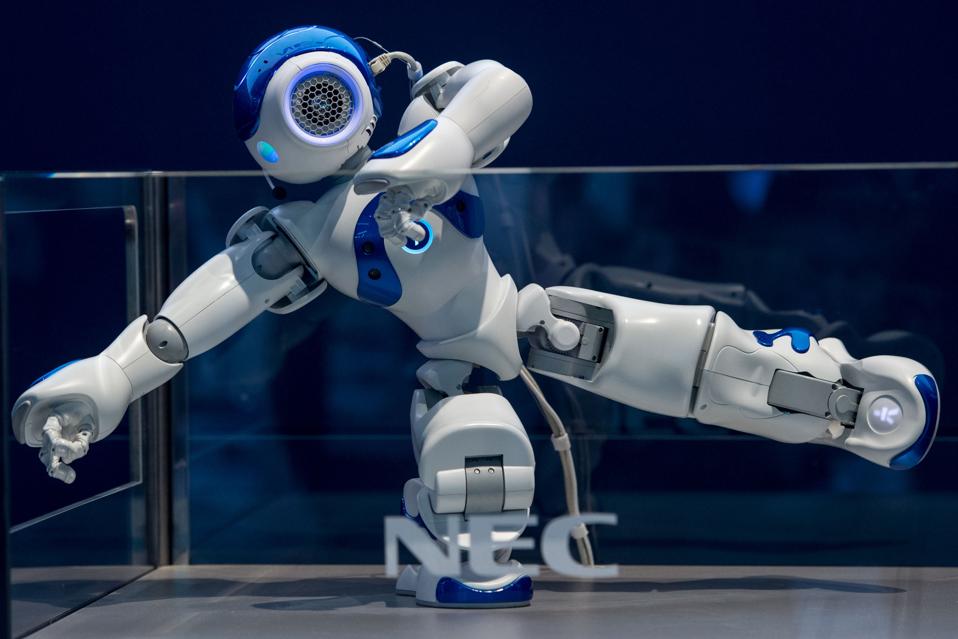
Realization of artificial intelligence

Project human artificial intelligence

  • Bringing Artificial Intelligence to the Edge of the IoT
    Today AI is successfully used to recognize faces and traffic signs, diagnose diseases and advance remedies, predict rainfall and con...
  • Những điều thú vị khi dùng Trí tuệ nhân tạo của Viettel
    Những người dùng Internet tại Việt Nam thường lấy “chị Google” ra để… giải trí. Khi “chị” đọc văn bản hay chỉ đường cho người tham gia gi...

Highlight

Những điều thú vị khi dùng Trí tuệ nhân tạo của Viettel

Những người dùng Internet tại Việt Nam thường lấy “chị Google” ra để… giải trí. Khi “chị” đọc văn bản hay chỉ đường cho người tham gia gi...

Tuesday, May 16, 2017

Better screenings through artificial intelligence

CSE assistant professor Xiaolei Huang aims to harness AI to improve medical imaging.
Artificial intelligence—commonly known as AI—is already exceeding human abilities. Self-driving cars use AI to perform some tasks more safely than people. E-commerce companies use AI to tailor product ads to customers’ tastes more quickly and precisely than any breathing marketing analyst can.
And soon AI will be used to “read” biomedical images more accurately than medical personnel alone—providing better early cervical cancer detection at lower cost than current methods.

However, this does not necessarily mean radiologists will soon be out of business.

“Humans and computers are very complementary,” says Xiaolei Huang, associate professor ofcomputer science and engineering. “That’s what AI is all about.”

Huang directs the Image Data Emulation and Analysis Laboratory, where she works on artificial intelligence related to vision and graphics, or, as she says, “creating techniques that enable computers to understand images the way humans do.” Among Huang’s primary interests is training computers to understand biomedical images.

Now, as a result of 10 years work, Huang and her team have created a cervical cancer screening technique that, based on an analysis of a very large dataset, has the potential to perform as well as, or better than, human interpretation or other traditional screening results, such as Pap tests and tests for human papilloma virus (HPV)—at a much lower cost. The technique could be used in less developed countries, where 80 percent of deaths from cervical cancer occur.
Huang’s screening system is built on image-based classifiers (an algorithm that classifies data) constructed from a large number of Cervigrams. Cervigrams are images taken by digital cervicography, a noninvasive visual examination method that takes a photograph of the cervix. The images, when read, are designed to detect cervical intraepithelial neoplasia (CIN), which is the potentially precancerous change and abnormal growth of squamous cells on the surface of the cervix.

“Cervigrams have great potential as a screening tool in resource-poor regions where clinical tests such as Pap and HPV are too expensive to be made widely available,” says Huang. “However, there is concern about Cervigrams’ overall effectiveness due to reports of poor correlation between visual lesion recognition and high-grade disease, as well as disagreement among experts when grading visual findings.”
Huang thought that computer algorithms could help improve accuracy in grading lesions by using visual information—a hunch that, so far, is proving correct.

They describe their results in an article in the March issue of Pattern Recognition titled “Multi-feature base benchmark for cervical dysplasia classification.”
Read the full story at the Lehigh University News Center.
-Lori Friedman is Director of Media Relations in the Office of Communications and Public Affairs at Lehigh University.
May 9, 2017
at May 16, 2017 No comments:
Email ThisBlogThis!Share to XShare to FacebookShare to Pinterest

The Lack of Intelligence About Artificial Intelligence


Everyone’s talking about artificial intelligence (“AI”). Most of the talk is wrong, misleading and often intended to frighten us about a future that’s unlikely to occur. AI will not steal our babies, hold us hostage for Bitcoins or start nuclear wars. But it will fundamentally change the labor market through the intelligent automation of many routine tasks individuals and companies perform all the time. First, let’s acknowledge the lack of intelligence around artificial intelligence. Members of the United States Congress know little or nothing about the technology – which is worrisome on many levels, especially when we consider the technology’s inevitable impact on the US and global economies. Most CEOs – and even most CIOs and CTOs – also know very little about AI – though when surveyed list AI as one of the most important technologies of the 21st century. The judicial system has its head in the sand. The general population understands AI the way Hollywood dramatizes it, like the way it was exhibited in 1992 in Minority Report and 1999 in The Matrix and, more recently, in Her and HBO’s Westworld. Try this: go to a party and randomly ask people what they think about AI. I’ve done it several times and the wordcloud shows robotics, Alexa, Watson and Westworld, but nothing about machine learning, knowledge representation or neural networks. Or about the impact it will inevitably have. Those who develop and sell AI understand the financial implications. Amazon, IBM, Google, Microsoft, Facebook, Apple, Intel and Baidu – among many others – are racing to sell vitamin pills and pain relievers – smart applications that can make money and save money. The CEOs, COOs, CIOs and CTOs are waiting impatiently to deploy applications that will save them time, effort and money – especially money they now spend on humans. They see AI as a cost manager and a profit center. But for the first time, AI will displace lots of knowledge workers – well-educated professionals – especially in the financial and service communities. AI’s impact on the transportation and manufacturing industries will also accelerate. Lots of pundits talk about the industries most likely to be impacted by AI, but very few talk about the small number of humans who create the technology, how the technology will inevitably become just another black box appliance or how the transition to machines will be managed. So what happens when displacement occurs? Hardly any of the pundits describe specific displacement management plans. This is the scary part of the story (not AI hostages or AI instigated Armageddon). How many industries and companies will know how – or even want – to manage displacement? Corporate HR departments will explode with complaints and lawsuits, and collapse under the weight of the exit packages they’ll be forced to give. Young and aging factory workers – and accountants, lawyers and doctors – will forget their purpose. Politicians will stare into the technology headlights – again – frozen by their own confusion and vested self-interests. Executives and shareholders will squeal with profitable delight. Universities will adjust their curricula or rapidly lose customers. Pain will pervade the corridors (but not the boardrooms) of the hard and soft industrial worlds, though this time the corridors will be wider and prettier than they’ve been in past displacement revolutions (because knowledge workers work in prettier places).
at May 16, 2017 No comments:
Email ThisBlogThis!Share to XShare to FacebookShare to Pinterest

Apple Just Acquired This Little-Known Artificial Intelligence Startup


Apple has acquired a data mining and machine learning company Lattice.io, according to multiple sources familiar with the matter.
Apple confirmed the acquisition exclusively to Fortune via telephone on Saturday, and provided the following statement via email: "Apple buys smaller technology companies from time to time, and we generally do not discuss our purpose or plans."
There isn't much information publicly available about Lattice, but according to the company's CrunchBase profile, the startup was born out a Stanford research project called DeepDive. The company's technology appears to use machine learning to parse through databases or the web to answer queries.
Get Data Sheet, Fortune’s technology newsletter.
Lattice was co-founded by Chris Re, a professor of computer science at Stanford, and Michael Cafarella, a professor of computer science at the University of Michigan. Cafarella was the co-creator of Hadoop, a widely used big data processing technology. Cafarella was also previously an engineer at telecommunications company TellMe Networks, which was bought by Microsoftin 2007 for $800 million.
According to this 2015 profile on Re, the professor's Deep Dive program is able to understand "dark data," which provides information within images or illustrations.
The company's technology is also similar to Google's Knowledge Graph (“GOOG”), which is the search giant's technology that understands relationships between people, places, and things, and it provide answers to questions like "What's the capital of California?"
One source familiar with the matter said the acquisition price was between $175 million and $200 million. Lattice had raised an undisclosed amount of funding from Madrona Venture Group and GV, the venture arm of Google-parent Alphabet.
Video link
at May 16, 2017 No comments:
Email ThisBlogThis!Share to XShare to FacebookShare to Pinterest

Google’s AI Invents Sounds Humans Have Never Heard Before


JESSE ENGEL IS playing an instrument that’s somewhere between a clavichord and a Hammond organ—18th-century classical crossed with 20th-century rhythm and blues. Then he drags a marker across his laptop screen. Suddenly, the instrument is somewhere else between a clavichord and a Hammond. Before, it was, say, 15 percent clavichord. Now it’s closer to 75 percent. Then he drags the marker back and forth as quickly as he can, careening though all the sounds between these two very different instruments.
“This is not like playing the two at the same time,” says one of Engel’s colleagues, Cinjon Resnick, from across the room. And that’s worth saying. The machine and its software aren’t layering the sounds of a clavichord atop those of a Hammond. They’re producing entirely new sounds using the mathematical characteristics of the notes that emerge from the two. And they can do this with about a thousand different instruments—from violins to balafons—creating countless new sounds from those we already have, thanks to artificial intelligence.


Engel and Resnick are part of Google Magenta—a small team of AI researchers inside the internet giant building computer systems that can make their own art—and this is their latest project. It’s called NSynth, and the team will publicly demonstrate the technology later this week at Moogfest, the annual art, music, and technology festival, held this year in Durham, North Carolina.
The idea is that NSynth, which Google first discussed in a blog post last month, will provide musicians with an entirely new range of tools for making music. Critic Marc Weidenbaum points out that the approach isn’t very far removed from what orchestral conductors have done for ages—“the blending of instruments is nothing new,” he says—but he also believes that Google’s technology could push this age-old practice into new places. “Artistically, it could yield some cool stuff, and because it’s Google, people will follow their lead,” he says.

The Boundaries of Sound

Magenta is part of Google Brain, the company’s central AI lab, where a small army of researchers are exploring the limits of neural networks and other forms of machine learning. Neural networks are complex mathematical systems that can learn tasks by analyzing large amounts of data, and in recent years they’ve proven to be an enormously effective way of recognizing objects and faces in photos, identifying commands spoken into smartphones, and translating from one language to another, among other tasks. Now the Magenta team is turning this idea on its head, using neural networks as a way of teaching machines to make new kinds of music and other art.
NSynth begins with a massive database of sounds. Engel and team collected a wide range of notes from about a thousand different instruments and then fed them into a neural network. By analyzing the notes, the neural net—several layers of calculus run across a network of computer chips—learned the audible characteristics of each instrument. Then it created a mathematical “vector” for each one. Using these vectors, a machine can mimic the sound of each instrument—a Hammond organ or a clavichord, say—but it can also combine the sounds of the two.
In addition to the NSynth “slider” that Engel recently demonstrated at Google headquarters, the team has also built a two-dimensional interface that lets you explore the audible space between four different instruments at once. And the team is intent on taking the idea further still, exploring the boundaries of artistic creation. A second neural network, for instance, could learn new ways of mimicking and combining the sounds from all those instruments. AI could work in tandem with AI.
The team has also created a new playground for AI researchers and other computer scientists. They’ve released a research paper describing the NSynth algorithms, and anyone can download and use their database of sounds. For Douglas Eck, who oversees the Magenta team, the hope is that researchers can generate a much wider array of tools for any artist, not just musicians. But not too wide. Art without constraints ceases to be art. The trick will lie in finding the balance between here and the infinite.
at May 16, 2017 No comments:
Email ThisBlogThis!Share to XShare to FacebookShare to Pinterest

Việt Nam đã ứng dụng trí tuệ nhân tạo như thế nào?


Việt Nam đã ứng dụng trí tuệ nhân tạo như thế nào?


Theo các chuyên gia, ứng dụng trí tuệ nhân tạo, Internet kết nối vạn vật (IoT) được coi là xu thế phát triển tất yếu của tương lai. Việt Nam đã ứng dụng những công nghệ như thế nào?
Trí tuệ nhân tạo, Internet kết nối vạn vật là thế hệ công nghệ mới giúp nâng cao hiệu suất lao động, cải thiện chất lượng sống của con người, đem đến cơ hội tăng trưởng kinh tế, phát triển kinh doanh cho các doanh nghiệp… Chính những thuận lợi đó mà Internet kết nối vạn vật (Internet of Things – IoT), trí tuệ nhân tạo đã là một xu hướng tất yếu hiện nay.
Dự kiến đến 2020, Internet of Things sẽ có 4 tỷ người kết nối với nhau, 4 ngàn tỷ USD doanh thu. Cùng với đó sẽ có hơn 25 triệu ứng dụng, 25 tỷ hệ thống nhúng và hệ thống thông minh cùng 50 ngàn tỷ Gigabytes dữ liệu được trao đổi.
Không chỉ trong bán hàng online, trí tuệ nhân tạo, Internet kết nối vạn vật (Internet of Things – IoT) đang được ứng dụng vào xe tự lái, robot làm lễ tân, nhận diện hình ảnh, giọng nói, điều trị ung thư… Việt Nam đang bắt đầu thử nghiệm một số ứng dụng trong số này.
Tiến tới xây dựng thành phố thông minh, các doanh nghiệp Việt Nam đang nghiên cứu các giải pháp tạo ra hệ thống kết nối Internet trong lĩnh vực giao thông, y tế, quản lý đô thị và cung cấp dịch vụ công…
Xem thêm video do VTV thực hiện Internet kết nối vạn vật (Internet of Things – IoT) đang được áp dụng tại Việt Nam
Video Player
    • TAGS
    • I
    at May 16, 2017 No comments:
    Email ThisBlogThis!Share to XShare to FacebookShare to Pinterest

    Wednesday, January 18, 2017

    How Artificial Intelligence Will Redesign Healthcare


    Artificial intelligence (AI) does more than execute code; it uses a range of strategies to recognize objects and behaviors, it understands speech and learns in response to changes in the data.
    Although AI is not intelligent in a conscious way, not yet at least, these abilities put AI-based applications in a position to make dramatic changes in many industries. Medicine and the healthcare professions are no exceptions.

    Data Driven Medicine Goes To Work

    AI has graduated from the university laboratory and gone to work in the world of industry and business. Current software applications can use advanced machine learning algorithms and artificial neural networks to crack complex problems that have evaded machines until now. This utility is helping the medical profession as much as any other.
    There are many exciting uses for AI in healthcare software, which are just now revealing themselves. The healthcare business will change in response to the newest technologies as AI provides new insights and clarity in diagnosis, care, and administration.
    The medical profession is undergoing a sea change in which practitioners seek to base decisions on data more than opinion and the eminence of authorities. This evidence-based medicine (EBM) is one of the factors in the changing architecture of the healthcare industry. The emergence of algorithms that deliver on the promise of AI is another paradigm-shifting factor.

    Watson The Oncologist And Other Amazing Machines

    Smart sensors connect Big Data to AI to give advanced warning of crisis events such as strokes and myocardial infarction. Systems such as Watson from IBM can find patterns within Big Data and recognize subtle physiological changes earlier than clinicians.
    AI systems deliver test results more quickly and prevent medication errors. By sifting through giant piles of data, AIs can test DNA and mine electronic health records (EHR). Automated telemedicine based on AI brings diagnosis to your home and deliver better care for chronic conditions.

    Consumer Services And The Changing Structure

    Hospitals will consolidate – These changes will cause Medical organizations to consolidate into larger more centralized facilities, and smaller hospitals will close down. More conditions will be treated as outpatient or by telemedicine; you’ll need to be sicker to get admitted to hospital.

    Check out how we helped build the world's first free-market telemedicine system for Video Medicine, Inc.


    Hospitals will be like ICUs – Hospital wards will be more like critical care units, where smart sensors and AI will predict crises before they become critical and alert staff to intervene.
    Storefront medicine – While clinics may concentrate resources, consumers will most likely meet clinicians at shopping center storefront medical outlets. These will probably be nurse practitioners, or patients will connect to doctors via telemedicine channels from home or mobile devices.
    Patients will control their EHR records – These electronic data compilations will be open to Big Data analytics. AI systems that mine EHRs will find information relating to individual patients and populations providing diagnoses and issues that require policy updates.
    A new healthcare professional will emerge – The new capabilities will change the nature of the medical profession and introduce new roles. The new jobs will go to personnel trained to work with physicians, to monitor and manage patient healthcare. This new career path will most likely combine data science with patient care and focus on providing a customer experience that is pleasant and efficient.
    Artificial intelligence will change medicine dramatically, making it more proactive and economical. The automated insights from data will alter the architecture of healthcare irreversibly. Hopefully, as the healthcare system becomes smarter, patients can look forward to better care experiences that result in more productive and happier lives.
    at January 18, 2017 No comments:
    Email ThisBlogThis!Share to XShare to FacebookShare to Pinterest

    Tuesday, January 10, 2017

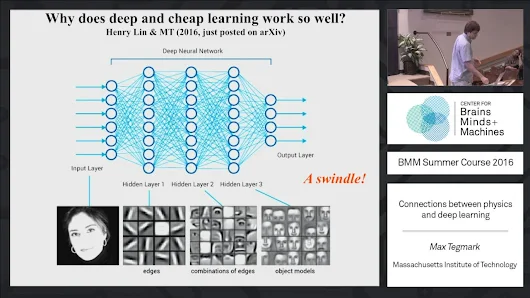
    Connections between physics and deep learning

    Connections between physics and deep learning

    Connections between physics and deep learning - YouTube
    at January 10, 2017 No comments:
    Email ThisBlogThis!Share to XShare to FacebookShare to Pinterest
    Newer Posts Older Posts Home
    Subscribe to: Posts (Atom)
    • Home page

    Search This Blog

    About Me

    lethanhphuong
    View my complete profile

    Blog Archive

    • ▼  2019 (3)
      • ▼  06/30 - 07/07 (3)
        • Những điều thú vị khi dùng Trí tuệ nhân tạo của Vi...
        • 3 Ways Artificial Intelligence Has Sparked Marketi...
        • 7 Types Of Artificial Intelligence
    • ►  2018 (54)
      • ►  09/09 - 09/16 (11)
      • ►  09/02 - 09/09 (20)
      • ►  08/26 - 09/02 (7)
      • ►  08/19 - 08/26 (16)
    • ►  2017 (87)
      • ►  06/25 - 07/02 (1)
      • ►  06/18 - 06/25 (8)
      • ►  06/11 - 06/18 (14)
      • ►  06/04 - 06/11 (16)
      • ►  05/28 - 06/04 (16)
      • ►  05/21 - 05/28 (12)
      • ►  05/14 - 05/21 (10)
      • ►  01/15 - 01/22 (1)
      • ►  01/08 - 01/15 (2)
      • ►  01/01 - 01/08 (7)
    • ►  2016 (455)
      • ►  12/25 - 01/01 (12)
      • ►  12/18 - 12/25 (2)
      • ►  12/11 - 12/18 (4)
      • ►  12/04 - 12/11 (15)
      • ►  11/27 - 12/04 (16)
      • ►  11/20 - 11/27 (6)
      • ►  11/13 - 11/20 (9)
      • ►  10/30 - 11/06 (1)
      • ►  10/23 - 10/30 (4)
      • ►  10/16 - 10/23 (12)
      • ►  10/09 - 10/16 (8)
      • ►  10/02 - 10/09 (8)
      • ►  09/25 - 10/02 (1)
      • ►  09/18 - 09/25 (16)
      • ►  09/11 - 09/18 (27)
      • ►  09/04 - 09/11 (6)
      • ►  07/31 - 08/07 (4)
      • ►  07/03 - 07/10 (4)
      • ►  06/26 - 07/03 (8)
      • ►  06/19 - 06/26 (3)
      • ►  06/12 - 06/19 (4)
      • ►  06/05 - 06/12 (5)
      • ►  05/29 - 06/05 (8)
      • ►  05/22 - 05/29 (8)
      • ►  05/15 - 05/22 (3)
      • ►  05/01 - 05/08 (4)
      • ►  04/24 - 05/01 (9)
      • ►  04/17 - 04/24 (16)
      • ►  04/10 - 04/17 (16)
      • ►  04/03 - 04/10 (16)
      • ►  03/27 - 04/03 (7)
      • ►  03/20 - 03/27 (18)
      • ►  03/13 - 03/20 (1)
      • ►  03/06 - 03/13 (24)
      • ►  02/28 - 03/06 (8)
      • ►  02/21 - 02/28 (64)
      • ►  02/14 - 02/21 (78)

    Report Abuse

    Translate

    The brain is a wonderful apparatus of nature

    The brain is a wonderful apparatus of nature

    Total Pageviews

    Followers

    search engine

    WebCrawler

    Search google

    Travel theme. Powered by Blogger.